

How CFO Mark Delaney unlocked sales tax refunds to drive major business expense reduction across six states
Follow Mark’s journey to see how overlooked financial data turned into a six-figure recovery.
Financial complexity increases as companies expand across state lines, especially when tax rules, vendor billing practices, and exemption requirements vary by jurisdiction. Many mid-sized manufacturers operate with lean finance teams focused on compliance and daily operations, leaving little time to revisit historical transactions for hidden errors. As a result, overpayments often remain buried in routine expenses.
Mark Delaney, CFO of a manufacturing company operating across six states, believed the company’s finances were in good shape. But tightening margins signaled that something was off. His core challenge was identifying whether years of unnoticed tax overpayments were preventing the company from recovering a legitimate, multi-year sales tax refund.
As margins tightened, CFO Mark Delaney realized the company may have overlooked years of sales tax overpayments, putting a legitimate multi-year refund at risk.
Keep reading to discover how a structured review revealed a significant recovery opportunity.
Navigating the Financial Landscape of a Manufacturing Firm
Mark’s company had grown steadily through regional expansion, new supplier relationships, and increased production capacity. Each move added operational complexity, particularly in how vendors charged sales and use tax across different states. Tax rules shifted, exemption eligibility varied, and invoice reviews focused more on payment accuracy than tax validation.
Over time, this environment created blind spots. Minor discrepancies, including misapplied tax rates, taxable classifications on exempt purchases, and inconsistent vendor billing, became normalized. Without a structured review process, these issues blended into standard operating costs.

Detailed financial review of invoices and tax records to uncover hidden overpayments and sales tax refund opportunities.
The Budget Review That Forced a Deeper Investigation
The breaking point came during a quarterly budget review with senior leadership. Rising material costs and freight expenses were already tightening margins, and every department was being asked to justify its upcoming expenditures.
As Mark walked through the financials, one trend stood out. Indirect tax expenses had increased steadily over several years, despite a relatively consistent purchasing volume.
Indirect tax costs kept rising even though purchasing volume stayed the same, revealing hidden inefficiencies.
The leadership team wanted clarity on why costs were rising in an area that should have been stable. Mark realized he could not give a precise explanation. Internal audits had confirmed compliance, but they had never focused on whether taxes charged by vendors were actually correct. His team ensured bills were paid, and returns were filed, but they did not have the time to recheck tax treatment across thousands of historical transactions.
After the meeting, Mark reviewed a small batch of invoices on his own. He quickly noticed inconsistencies. Similar items were taxed differently by different vendors. Some purchases that should have qualified for exemption had full tax applied.
In other cases, tax appeared to be layered on top of use tax accruals. These were not dramatic errors on single invoices, but patterns that could accumulate into significant overpayments.
A quick invoice review exposed patterns of misapplied tax, pointing to years of potential sales tax refund opportunities.
At that moment, Mark understood the scale of the issue. Recovering a legitimate sales tax refund would require a structured, multi-year comprehensive expense analysis reconstruction supported by specialized tax expertise, not a simple internal review.
Determined not to let potential recoveries slip away, he decided it was time to bring in outside specialists who could thoroughly investigate past overpayments and determine whether the company was owed meaningful recoveries tied to a sales tax refund.
How The SALT Group Uncovered a $385K Sales Tax Refund Through Expert Expense Review and AnalysisReconstruction
Mark began looking for a firm with deep multi-state tax expertise and a proven process for large-scale and comprehensive expense analysisreconstruction. He needed specialists who could analyze years of transactions without overwhelming his internal team. That search led him to The SALT Group.
From the outset, their approach was different. Instead of sampling invoices or reviewing only recent periods, The SALT Group performed a comprehensive historical analysisreconstruction of transaction data across vendors, purchase categories, and state jurisdictions. Their consultants examined how sales and use tax had been applied line by line, validating taxability, exemption eligibility, and vendor billing accuracy.
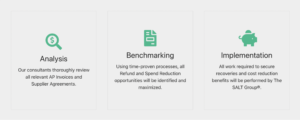
The review revealed consistent patterns of overpayment. Vendors had applied tax based on default settings rather than product-specific tax rules. Exemption documentation had not always been used at the point of sale. In some cases, use tax had been accrued even when sales tax had already been charged.
Individually, these discrepancies were small. Across multiple years and thousands of invoices, they accumulated into a substantial sales tax refund opportunity.
The SALT Group managed the end-to-end process, including documentation, jurisdictional analysis, and direct coordination with state tax authorities. Because the engagement was performance-based, Mark’s company faced no fee until refunds and other benefits were identifiedBecause the engagement was performance-based, Mark’s company faced no upfront cost and paid only from realized recoveries.
The results confirmed the scope of the issue. The structured review secured a $385,000 sales tax refund across multiple states by recovering accumulated overpayments and introduced stronger controls that supported long-term business expense reduction.
Through a structured, performance-based Sales Tax Refund review, The SALT Group analyzed multi-year, multi-state transactions, coordinated directly with state tax authorities, and recovered $385,000 in overpaid sales tax with no upfront cost to the company.
From Hidden Overpayments to Lasting Financial Control
Mark’s experience demonstrated that hidden overpayments can quietly erode profitability even in well-managed finance environments. Through a specialist-led detailed expense review and analysis, reconstruction, his company recovered significant funds while strengthening tax oversight and financial controls for the future.
The SALT Group’s performance-based model, deep multi-state tax expertise, and established relationships with state tax authorities ensured the recovery process was thorough, low risk, and minimally disruptive.
More importantly, the engagement improved vendor tax oversight and exemption handling going forward. For finance leaders facing margin pressure, the opportunity may lie not in cutting operations, but in recovering money already paid.
Turn historical overpayments into recovered cash with a performance-based Sales Tax Refund review.
Explore Recovery Opportunities.
FAQs
1. What is a sales tax refund, and how can a business qualify?
A sales tax refund allows a business to recover overpaid sales or use tax caused by vendor mischarges, incorrect tax treatment, or missed exemptions. Companies operating in multiple states often qualify due to varying tax rules and billing inconsistencies.
2. How does an expense review and analysisreconstruction help identify tax overpayments?
A detailed Eexpense review and analysisreconstruction involves reviewing historical transaction data in detail to verify whether tax was applied correctly. This structured process uncovers patterns of overpayment that routine audits or surface-level reviews typically miss.
3. Is business expense reduction only about cutting current costs?
No. Business expense reduction also includes recovering historical overpayments and correcting systemic billing issues. This approach improves long-term financial accuracy without disrupting core operations.
4.Will a sales tax refund review create extra work for internal teams?
Specialist firms typically manage the analysis, documentation, and filing process. This allows internal finance teams to maintain daily operations while experts focus on identifying and recovering eligible overpayments.
Turn Overlooked Transactions Into Measurable Financial Recovery
Hidden tax overpayments can quietly drain margins, but structured and detailed expense review and analysisreconstruction can uncover a meaningful sales tax refund and support lasting business expense reduction.
Key Learnings
- Multi-state operations increase the risk of inconsistent tax treatment and vendor mischarges
- Routine audits confirm compliance but rarely uncover historical overpayments
- A detailed review and analysisExpense reconstruction reveals patterns that invoice-level checks often miss
- Recovering a sales tax refund can free capital without cutting operations
- Specialist-led reviews minimize internal workload while maximizing recovery
Recover overlooked overpayments and strengthen financial accuracy with The SALT Group.
Powered by MarketEngine from StartupWind