
Explore six accounts payable approval risks that can lead to duplicate payments, unauthorized spending, and avoidable financial losses.
Could approved invoices still be hiding unnecessary costs? Answer a few questions to identify potential areas of vendor cost exposure and find out what may deserve a closer review.
An approved invoice is not necessarily a correct invoice.
A manager can authorize a payment on time, the documentation can appear complete, and the transaction can pass through the company’s usual workflow. Yet the business may still pay for undelivered goods, duplicate charges, unauthorized purchases, or services billed at outdated rates. Strong accounts payable controls help reduce these risks, but approval alone does not guarantee that a transaction is accurate or supported.
The risk of duplicate invoices remains a concern for accounts payable teams. According to the 2025 Accounts Payable Leadership Priorities Report, 20% of AP teams identified invoice duplication as a key risk concern. This highlights why invoice verification and approval procedures need to catch duplicate charges before payment.
For mid-sized manufacturers and multi-location businesses, the challenge goes beyond keeping invoice processing on schedule and ensuring that each transaction receives the necessary scrutiny. Finance teams must verify recurring service charges, maintain consistent approval controls across locations, and identify discrepancies without diverting excessive time from core responsibilities. As vendor relationships and operating costs change, gaps in these checks can allow preventable losses to accumulate.
The exposure can grow as businesses expand. Manufacturers add facilities, distributors manage larger supplier networks, and finance teams handle higher volumes of invoices across departments and locations. Meanwhile, approval limits change, contracts renew, and employees take on overlapping responsibilities. Without clear procedures and regular reviews, informal workarounds can become routine, leaving important checks dependent on individual judgment rather than consistent controls. These gaps can affect invoice processing when routine checks depend on individual judgment rather than documented procedures.
The consequences extend beyond individual payment errors. Weak accounts payable controls can tie up working capital, increase administrative costs, complicate financial reporting, and allow small overpayments to accumulate across recurring transactions.
The solution is not to add another approval layer to every invoice. It is to identify where controls are most likely to fail, establish clear accountability, and ensure that exceptions receive appropriate scrutiny.
Recurring approval gaps can allow duplicate payments, unauthorized spending, and avoidable costs to continue unnoticed. Reviewing these six accounts payable approval risks can help your finance team identify control weaknesses, prioritize corrective action, and reduce the chance of preventable losses recurring.
- Invoices approved without proper verification
- Duplicate invoices passing through approval
- Approval limit and delegation-of-authority violations
- Self-approval and weak segregation of duties
- Missing purchase order and contract validation
- Unauthorized changes or overrides in the accounts payable approval workflow
What is the difference between preventive and detective accounts payable controls?
Preventive controls aim to stop errors before payment, such as requiring approval limits or matching invoices to purchase orders during invoice processing. Detective controls identify issues that pass through, such as duplicate-payment reports, reconciliations, and periodic transaction reviews. Strong programs use both.
1. Invoices Approved Without Proper Verification
What it is
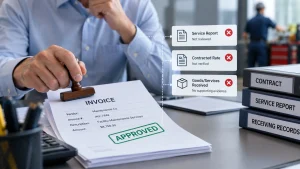
This accounts payable approval risk occurs when an approver authorizes an invoice without sufficient evidence that the transaction is legitimate, the amount is correct, and the goods or services were delivered as agreed. A consistent invoice processing review should establish whether the supporting evidence substantiates the amount being requested.
A familiar vendor name, a plausible invoice amount, or a department manager’s sign-off may create a false sense of assurance. None of these details independently confirms that the billed quantity, agreed price, service scope, and additional charges are accurate.
Consider a manufacturer receiving a maintenance invoice for work performed at one of its facilities. The manager recognizes the vendor and approves the charge without checking the technician’s service report or the contracted hourly rate, allowing an error to pass through invoice processing. The work may have been completed, but the business could still be paying for excessive hours or an incorrect rate.
Why it matters
- A service may have occurred while records still reflect incorrect hours, quantities, or rates.
- Missing receiving records, service reports, or contracts can prevent reviewers from validating charges during invoice processing.
- A minor rate discrepancy repeated across multiple invoices may become a material expense over time.
- A recorded sign-off does not prove that the underlying transaction was checked against relevant evidence.
- Once payment is made, retrieving records and challenging a charge can require additional time and vendor correspondence.
Pro Tip: Before approving an invoice, match the billed quantities, prices, and completed work against purchase orders, delivery receipts, service records, and applicable contracts. This check makes invoice processing more reliable by linking approval to evidence of the goods or services received. Investigate discrepancies before authorizing payment, and retain the supporting documentation for future reviews.
What are common red flags of invoice fraud?
Common warning signs include unexpected bank-detail changes, unfamiliar suppliers, unusual urgency, inconsistent invoice or purchase-order information, and charges that differ from agreed terms. A single red flag does not prove fraud, but it should trigger independent verification before the invoice is approved or paid.
2. Duplicate Invoices Passing Through Approval
What it is
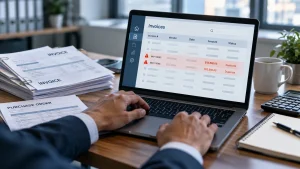
Duplicate invoice risk arises in accounts payable when the same underlying obligation is entered or submitted more than once and multiple records progress toward payment.
Duplicates can result from vendors resending invoices, submitting revised documents without identifying the original, or using multiple submission channels. Internal teams may also enter the same invoice twice when processing combines manual entry with electronic intake. When invoice processing involves both manual entry and electronic intake, duplicate records can be harder to identify.
The records do not always look identical. A vendor might alter the invoice-number format, change the document date, or adjust a reference field. Exact-match checks during invoice processing may fail to identify these cases.
Why it matters
- A duplicate payment ties up funds that could be used for legitimate operating needs.
- Obtaining a refund or credit may require vendor correspondence and reconciliation.
- Slight differences in numbering or dates may prevent an exact-match control from flagging the record.
- Separate facilities may submit the same supplier invoice through different channels.
- Finance staff must investigate the duplicate, contact the supplier, and track the recovery.
Pro Tip: During invoice processing, compare multiple attributes, including vendor identifiers, invoice numbers, amounts, dates, purchase orders, and transaction references. Configure duplicate-detection rules to flag likely matches even when document details differ slightly.
Route flagged transactions for human review instead of rejecting every match automatically. Recurring invoices, legitimate installments, and credit-and-rebill transactions may resemble duplicates but represent valid obligations.
3. Approval Limit and Delegation-of-Authority Violations
What it is
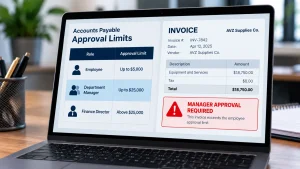
Accounts payable approval limits define who can authorize a transaction and when additional authorization is required. These rules help ensure that invoice processing routes transactions to someone with the appropriate authority
Violations occur when an employee approves an invoice above their limit, an unauthorized person provides approval, or a purchase is divided into smaller transactions to avoid a higher approval threshold.
These problems can emerge when approval matrices are outdated, job responsibilities change, or temporary delegations are arranged informally. A workflow may continue routing invoices to someone whose authority no longer matches their role, weakening controls over invoice processing.
For example, a department manager authorized to approve expenses up to $10,000 might approve a $28,000 invoice without obtaining the additional authorization required by company policy.
Why it matters
- Accounts payable transactions may proceed without the financial scrutiny required by company policy.
- Repeated purchases just below an approval threshold may indicate an attempt to avoid escalation, but the pattern should be investigated before concluding that a policy violation has occurred.
- Former responsibilities or informal delegations can leave approval rights in the wrong hands.
- Outdated approval records can cause invoice processing to follow an authorization path that no longer reflects company policy.
- Without a clear record of who approved a transaction and under what authority, exception reviews take longer.
- Unauthorized commitments can make expenditure forecasts and departmental accountability less dependable.
Pro Tip: Maintain a current approval matrix covering transaction limits, departments, escalation rules, and permitted delegations. Keeping these records current helps invoice processing follow the correct escalation path when transaction values exceed an approver’s limit.
Review accounts payable approval permissions whenever job responsibilities or delegations change. Configure the workflow to use the applicable authorization rules rather than relying solely on job titles or manually selected approvers.
Review repeated purchases just below approval thresholds to determine whether they reflect legitimate purchasing patterns, fragmented requirements, or possible attempts to avoid escalation. Investigate the circumstances before concluding that a policy violation has occurred.
4. Self-Approval and Weak Segregation of Duties
What it is
Segregation of duties distributes responsibilities so that no individual has unrestricted control over every important stage of a transaction. In accounts payable, those responsibilities can include maintaining vendor records, entering invoices, approving expenditure, releasing payments, and reconciling bank activity.
Self-approval occurs when an individual authorizes their own transaction. A related risk arises when one person controls several stages without an effective independent review. Smaller finance teams may need employees to perform overlapping duties, but those arrangements require compensating controls. These arrangements can weaken invoice processing controls when no independent review compensates for the overlap.
Imagine an employee who can create a vendor, enter its invoices, approve charges, and initiate payments. If an error or unauthorized transaction enters the system, the same individual may be able to advance it without meaningful independent scrutiny.
Why it matters
- An incorrect code or amount may remain undetected when no independent person reviews the transaction.
- One person controlling vendor setup, invoice entry, and payment release within accounts payable can bypass important checks.
- A sign-off is not independent oversight if the approver also created or changed the transaction.
- Limited staffing does not remove the need for review; it changes how the review must be designed.
Pro Tip: Separate vendor maintenance, invoice approval, payment release, and reconciliation wherever practical.
When staffing constraints prevent full segregation, introduce compensating controls to maintain accounts payable oversight. These may include independent review of vendor changes, secondary authorization for high-risk payments, periodic examination of payment files, and documented oversight by a controller or finance leader.
Review access permissions regularly, especially after employee transfers or departures. Documented independent reviews help maintain oversight of invoice processing when complete segregation is impractical.
What evidence should a business retain for an accounts payable audit?
Keep the invoice, purchase order or contract, proof of receipt or service, approval history, records of material edits, exception rationale, and payment confirmation. Retain these records under the company’s document-retention policy so reviewers can trace who authorized the transaction and why.
5. Missing Purchase Order and Contract Validation

What it is
This accounts payable control risk occurs when an invoice is approved without confirming that the purchase was authorized and that the charges reflect the applicable purchasing terms.
Purchase orders can establish approved quantities, prices, and scope. Contracts may define recurring charges, payment terms, service levels, escalation provisions, and other conditions. Depending on the transaction, both documents or an approved alternative may be needed to validate the expense.
Problems arise when supporting documents are missing, purchase orders are created after commitments have been made, or contract changes are not reflected in the review process. Without these checks, invoice processing may confirm that a document is complete without establishing that the charges match the agreed terms.
For example, a facilities vendor may invoice a business for a higher monthly fee following an automatic contract escalation. The service was delivered, and the invoice amount is mathematically correct, but invoice processing may overlook the increase if it is not checked against the agreed terms.
Why it matters:
- Invoices may reflect outdated rates after a contract renewal or pricing change.
- Recurring fees can continue even after service requirements or operational needs have changed.
- Charges for unnecessary services or an outdated scope of work can go unnoticed when reviews focus only on invoice totals.
- Missing purchase-order or contract checks can make it harder to identify discrepancies between agreed terms and billed amounts.
- Repeated overcharges across accounts payable transactions, locations, or billing periods can accumulate into significant avoidable costs.
Real-world example
Midland Farms, Inc., a dairy processing and distribution business, partnered with The SALT Group and identified $254,592.12 in savings across waste, sales and use tax, and utility expenses. The client information also reports $276,000 in sales and use tax paid in error on electricity, with the issues having existed for more than two years. This illustrates why reviewing recurring operating costs can uncover issues that routine invoice processing approval may not identify.
The example illustrates the value of examining recurring operating expenses beyond individual invoice approvals. For businesses concerned about costs that may remain undetected through routine reviews, a broader cost-recovery assessment can be a complementary next step.
Pro Tip: Require a valid purchase order or a documented exception for transactions outside purchase-order requirements. Compare quantities, rates, and service descriptions against the relevant authorization.
Keep current contracts and rate schedules accessible to reviewers to strengthen accounts payable checks. During invoice processing, flag automatic price increases, new fees, changes in service scope, and expired agreements for additional scrutiny before approval.
For recurring services, periodically compare billed services with actual operational requirements. This can reveal discrepancies that individual invoice checks may not identify.
6. Unauthorized Changes or Overrides in the Accounts Payable Approval Workflow

What it is
Accounts payable approval workflows determine who reviews a transaction, what evidence is required, and when an invoice can proceed to payment.
This risk arises when someone changes approval routing, substitutes an approver, edits invoice details after approval, bypasses a required check, or uses an exception process without appropriate authorization. Effective invoice processing controls should preserve the approval trail when routing, transaction details, or authorization requirements change.
Not every override is improper. Urgent payments, employee absences, and system failures may require legitimate exceptions. The problem occurs when those exceptions are unrestricted, poorly documented, or invisible to the people responsible for oversight.
For example, an invoice may be approved for one amount and subsequently edited before invoice processing is complete and payment is released. If the change does not trigger a new review, the payment may proceed using an authorization that no longer reflects the transaction.
Why it matters
- Material edits during invoice processing can change the transaction that the approver actually reviewed.
- Without logs, finance may not be able to establish who changed a record, when, or why.
- Unrestricted overrides may defeat approval limits or independent review.
- Changes to bank or remittance details can create misdirection and fraud exposure.
- Frequent exceptions can indicate that the workflow or policy needs to be corrected rather than bypassed.
How often should a company review its accounts payable controls?
Review accounts payable controls on a defined schedule, such as quarterly or annually based on transaction volume and risk. Reassess them sooner when staffing, approval limits, systems, or vendor arrangements change, and investigate unusual payment patterns or recurring exceptions as they arise.
Pro Tip: Restrict accounts payable workflow configuration and override permissions to designated administrators. Maintain logs of changes to invoice amounts, vendor details, payment instructions, approval assignments, and workflow rules.
Require renewed approval when a material change affects an already-authorized transaction. Review overrides periodically, investigate unusual patterns, and document the reason for each legitimate exception.
Six Accounts Payable Approval Risks to Review
Invoice approval does not guarantee that a transaction is accurate, authorized, or aligned with agreed terms. Weak verification, duplicate invoices, outdated approval limits, inadequate segregation of duties, missing contract checks, and uncontrolled workflow changes can allow errors and avoidable costs to pass through accounts payable controls.
Testing completed transactions helps establish whether invoice processing consistently follows documented verification and authorization procedures.
Here are the key findings:
- Approval is not proof of accuracy: Supporting records must substantiate the charges.
- Duplicate checks need more than exact matches: Differences in invoice details can hide potential duplicates.
- Authorization must remain current: Outdated permissions and informal delegations can weaken oversight.
- Independence matters: Smaller teams may need compensating controls when duties overlap.
- Contract terms need validation: Correct calculations do not guarantee that prices or service charges are appropriate.
- Workflow exceptions need scrutiny: Material changes and overrides require appropriate authorization and documentation.
Protect Cash Flow and Profit Margins With Stronger Accounts Payable Controls
Strong accounts payable controls help finance teams verify that invoices are accurate, authorized, and supported by appropriate documentation. Reviewing approval limits, duplicate-payment checks, purchase-order validation, and exceptions in invoice processing can help reduce preventable payment errors.
However, an approved invoice may still include excessive service charges, outdated rates, unnecessary service scope, or tax overpayments that routine approval procedures are not designed to identify.
For mid-sized manufacturers and multi-location businesses, managing invoice processing goes beyond timely payments. Finance teams must verify charges, maintain consistent accounts payable controls across sites, and identify discrepancies despite competing responsibilities and limited specialized expertise.
As vendor relationships and operating costs change, gaps in these checks can allow preventable losses to accumulate. Combining transaction-level accounts payable controls with broader operating cost reviews helps finance teams detect approval errors, assess recurring expenses and supplier charges, and identify potential tax overpayments that routine invoice checks may miss.
The SALT Group helps businesses identify overlooked overpayments and optimize operating costs across selected categories, including Sales & Use Tax, Waste, Freight, Parcel, Uniforms & Facilities, and Merchant Card Services. Its performance-based model ties fees to identified recoveries and savings under the engagement terms, while its turnkey approach minimizes the time and effort required from internal teams. Dedicated consulting teams bring specialized expertise to the spend categories they review, and a dedicated client manager coordinates the engagement.
This gives finance leaders a way to examine potential overpayments beyond routine accounts payable controls without taking on the full burden of conducting every review internally. SALT’s work complements the company’s own approval procedures; it does not replace the need for sound internal controls.
Uncover Hidden Overpayments and Protect Your Profit Margins With The SALT Group.
FAQs
1. How can finance teams tell whether their accounts payable controls are working?
Finance teams can test a sample of completed accounts payable transactions against the company’s approval policy. The review should confirm that supporting evidence was available, approvers had valid authority, duplicate flags were investigated, and material changes triggered the required review. Recurring exceptions and the effectiveness of corrective actions should also be tracked.
2. What should be investigated when an invoice is flagged as a possible duplicate?
The review should compare the vendor, invoice number, amount, date, purchase order, and transaction history. It should also establish whether the document represents a legitimate installment, credit-and-rebill, or revised invoice. A potential match should trigger investigation rather than automatic rejection.
3. How can businesses maintain effective controls with a small finance team?
Businesses can identify duties that create the greatest exposure when one person controls a transaction from beginning to end. Where complete segregation is impractical, documented independent reviews of high-risk vendor changes, significant payments, and periodic payment reports can provide compensating controls. System access should also be reviewed when responsibilities change.
4. Can a business still overpay if every invoice has been approved?
Yes. Approval confirms that a transaction passed the required authorization steps, but it does not necessarily establish that every charge is commercially reasonable or tax-correct. Comparing recurring charges with contracts, agreed rates, actual service requirements, and applicable tax rules can reveal issues that routine approval checks may not detect. A specialist review can complement internal controls when broader operating cost leakage is suspected.
Turn Approval Controls Into a Financial Safeguard
A reliable approval process protects cash, reinforces purchasing authority, and makes exceptions visible before they become recurring losses. The objective is to prevent errors without creating unnecessary payment delays.
Remember these six principles:
- Verify a sample of invoices against delivery and service evidence.
- Check duplicate flags and review potential matches.
- Confirm approval limits and delegation records are current.
- Test independent reviews where duties overlap.
- Compare recurring charges against current contracts and service requirements.
- Review material changes and overrides for authorization and documentation.
Reviewing approval controls is an important first step, but recurring supplier charges and other operating expenses may warrant a closer look even after invoice processing approval procedures are in place. Identifying these issues early can help your team address potential cost leakage before it continues.
If your team has reviewed its accounts payable approval controls but still has questions about recurring supplier charges, service costs, or potential tax overpayments, explore how The SALT Group can help identify cost-recovery opportunities across selected operating expense categories.