

Discover how effective spend management reduces vendor costs and improves business expense management.
Talk to a Spend Management Expert
Executive Summary
What is Vendor Spend Management?
Vendor spend management is the process of tracking, analyzing, and optimizing the money a business spends with suppliers to reduce unnecessary costs and improve profitability. Effective spend management helps organizations identify savings opportunities, strengthen vendor oversight, and make more informed purchasing decisions.
What is spend management consulting?
Spend management consulting helps businesses analyze and optimize supplier spending to reduce unnecessary costs, recover overpayments, and improve procurement performance. Consultants identify hidden cost leakage, strengthen purchasing controls, and create strategies for sustainable savings.
Mid-sized businesses can lose significant amounts of money through vendor costs that receive little ongoing scrutiny. Hidden overcharges, unchecked fees, duplicate payments, and small invoice discrepancies can accumulate over time, quietly eroding margins.
The challenge is widespread. 93% of procurement leaders say maverick spend remains an issue for their organizations, affecting forecasting, planning, and cash flow.
Additionally, 26% of procurement teams manually intervene in more than 500 invoices each year, creating more opportunities for invoice errors, duplicate payments, and overpayments to go undetected.
Without structured oversight, these seemingly small issues can become recurring sources of cost leakage, reducing profitability and limiting the savings available for growth.
This guide explains how vendor spend management can help businesses identify hidden cost leakage, recover historical overpayments, strengthen vendor controls, and sustain savings over time. It also introduces the TSG Vendor Spend Optimization Framework™, a six-step approach for turning vendor spend analysis into measurable cost savings.
Why Vendor Spend Management Matters
Vendor spend management matters because small pricing discrepancies, recurring fees, unnecessary services, and contract leakage can compound into significant operating costs. A structured approach helps businesses identify these issues, recover money already lost, and prevent similar costs from recurring.

What do spend management consultants do?
Spend management consultants review vendor contracts, invoices, pricing, and procurement processes to uncover hidden savings opportunities. They help businesses improve business expense management by identifying overpayments, negotiating better supplier terms, and implementing stronger spend controls.
Why Traditional Cost Reduction Strategies Often Fall Short
Many organizations reduce costs by freezing budgets, delaying investments, or cutting discretionary spending. While these actions may deliver short-term relief, they rarely address the hidden overpayments, pricing discrepancies, contract leakage, and recurring vendor fees that quietly reduce profitability over time.
Learn What Traditional Strategies Miss
The Hidden Cash Sitting Inside Vendor Spend
Hidden savings often exist within everyday vendor transactions. Duplicate payments, invoice errors, unnecessary services, pricing inconsistencies, and overlooked contract terms can accumulate into significant financial losses. Identifying and recovering these costs helps improve cash flow without disrupting business operations.
Find Hidden Savings Opportunities
Why Vendor Spend Management Is Critical for Manufacturers
Manufacturers rely on extensive supplier networks for raw materials, freight, waste management, facilities, and other operational services. Without ongoing visibility into vendor spending, unnecessary costs can quickly accumulate. Vendor spend management helps manufacturers improve cost control, strengthen supplier accountability, and protect profit margins.
See How Manufacturers Strengthen Profitability
How Vendor Spend Management Supports Sustainable Cost Reduction
Lasting cost reduction isn’t achieved through one-time budget cuts; it’s built through continuous visibility and optimization. Vendor spend management helps businesses identify recurring cost leakage, improve purchasing decisions, and maintain long-term savings across critical spend categories.
Learn How to Build Long-Term Savings
When to Consider Cost Control Strategy Consultants
If your finance or procurement team lacks the time, resources, or specialized expertise to analyze vendor spending, outside experts can uncover opportunities that are often overlooked. Performance-based consultants help identify hidden savings, optimize vendor costs, and deliver measurable results with minimal internal effort.
See When Expert Support Can Maximize Savings
How Vendor Spend Management Works: The TSG Vendor Spend Optimization Framework™
The TSG Vendor Spend Optimization Framework™ is a structured six-step methodology for uncovering hidden vendor costs, recovering overpayments, and building sustainable procurement controls that improve profitability without disrupting day-to-day operations.
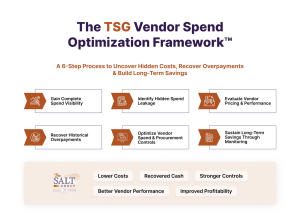
Step 1. Gain Complete Visibility Into Your Vendor Spend
What It Is
Effective vendor spend management begins with complete visibility into every supplier, contract, invoice, and recurring expense. Centralizing vendor data allows finance and procurement teams to understand where money is being spent before identifying savings opportunities or controlling unnecessary costs.
How to Implement
- Centralize Vendor Records: Consolidate contracts, invoices, purchase orders, and payment data from every department into a single source of truth.
- Categorize Business Spend: Group expenses by supplier, spend category, department, and location to understand spending patterns and priorities.
- Map Recurring Expenses: Identify subscriptions, service agreements, maintenance contracts, and automatically renewing vendor commitments.
Pro Tip: Don’t focus only on large suppliers. Smaller recurring vendors often generate significant cumulative spend and frequently receive less oversight, making them common sources of hidden cost leakage.
Step 2. Identify Hidden Spend Leakage
What It Is
After gaining visibility into supplier spending, the next step in business expense management is identifying hidden cost leakage. Review invoices, contracts, and payment records to uncover duplicate payments, billing errors, pricing discrepancies, unnecessary services, and overlooked vendor fees that quietly reduce profitability.
How to Implement
- Review Vendor Invoices: Examine invoices to identify duplicate payments, incorrect tax charges, billing errors, unauthorized fees, and pricing inconsistencies before they become recurring costs.
- Compare Contracts with Invoices: Verify that invoices match negotiated pricing, discounts, service levels, and contractual terms to detect contract leakage and vendor overcharges.
- Analyze Spending Patterns: Monitor historical vendor spending to identify recurring cost increases, unusual spending trends, and opportunities for better cost control.
Pro Tip: Recurring invoice increases often indicate hidden vendor cost leakage. Reviewing spending trends instead of isolated invoices helps businesses identify issues that significantly impact long-term business expense management.
Step 3. Evaluate Vendor Pricing, Performance & Savings Opportunities
What It Is
Effective spend management isn’t just about reducing costs; it’s about ensuring every supplier delivers value. Evaluating pricing, service quality, contract compliance, and operational performance helps businesses identify savings opportunities while improving supplier relationships and purchasing decisions.
How to Implement
- Benchmark Supplier Pricing: Compare vendor pricing with current market rates and industry benchmarks to identify opportunities for renegotiation.
- Evaluate Supplier Performance: Measure delivery reliability, service quality, responsiveness, and compliance with agreed contractual obligations.
- Prioritize High-Value Opportunities: Focus negotiations on vendors with the highest annual spend, greatest savings potential, or upcoming contract renewals.
Pro Tip: Benchmark supplier pricing before every major contract renewal. Current market comparisons strengthen negotiating leverage and prevent unnecessary cost increases from becoming long-term commitments.
What are vendor pricing mechanics?
Vendor pricing mechanics are the pricing structures, discounts, surcharges, contract terms, and fee models that determine how suppliers charge for their products or services. Understanding these pricing components is essential for effective spend management and vendor cost optimization.
Step 4. Recover Historical Overpayments
What It Is
Many organizations focus on future savings while overlooking money they’ve already lost. Reviewing historical invoices, tax payments, and vendor transactions helps recover past overpayments while strengthening business expense management processes to prevent similar issues from recurring.
How to Implement
- Review Historical Transactions: Analyze previous invoices and payment records for duplicate payments, billing errors, and pricing discrepancies.
- Validate Recovery Opportunities: Confirm identified overpayments using contracts, supporting documentation, and payment histories before initiating recovery.
- Recover Eligible Funds: Work with vendors or tax authorities to recover refunds, credits, or overpaid amounts wherever applicable.
Pro Tip: Historical overpayment reviews often reveal recurring process weaknesses. Correcting these issues improves future business expense management while maximizing the value of every recovery effort.
Step 5. Optimize Vendor Spend and Procurement Controls
What It Is
Once unnecessary costs have been eliminated, businesses should strengthen procurement controls to maintain long-term savings. Well-defined purchasing policies, approval workflows, and vendor governance improve spend management while reducing future cost leakage.
How to Implement
- Standardize Procurement Policies: Establish consistent purchasing procedures, spending guidelines, and procurement standards across departments.
- Strengthen Approval Processes: Define approval thresholds and purchasing authority to improve financial oversight without slowing operations.
- Enhance Vendor Governance: Schedule regular supplier reviews to evaluate pricing, service performance, and contractual compliance.
Pro Tip: Effective procurement controls should improve visibility and accountability without introducing unnecessary administrative complexity that delays purchasing or discourages policy compliance.
Step 6. Sustain Long-Term Savings Through Continuous Monitoring

What It Is
Successful spend management is an ongoing process. Regularly monitoring vendor spending, supplier performance, and contract compliance helps businesses identify new savings opportunities, prevent recurring cost leakage, and continuously improve business expense management.
How to Implement
- Monitor Vendor Spending: Review supplier costs, invoice accuracy, and spending trends through regular reporting and analysis.
- Evaluate Supplier Performance: Measure vendors against pricing, service quality, responsiveness, and contractual commitments.
- Track Savings Performance: Monitor recovered overpayments, realized savings, and procurement KPIs to measure the effectiveness of your spend management strategy.
Pro Tip: Schedule comprehensive vendor spend reviews before contract renewals. Early reviews provide stronger negotiating leverage and help prevent automatic price increases from affecting future operating costs.
Real-World Examples Of Business Expense Management
No two organizations lose money in the same way. At The SALT Group, we’ve worked with manufacturers and other mid-sized businesses that either struggled with hidden vendor cost leakage or proactively optimized their spend. These two examples illustrate the difference.
Bad Example: Cost Cutting Didn’t Stop Profit Leakage
I met the CFO of a mid-sized plastics manufacturer after several rounds of company-wide cost-cutting. Budgets had been frozen and discretionary spending reduced, yet profit margins continued to decline.
What we found:
- Automatic contract price increases had gone unnoticed for years.
- Duplicate invoice payments were slipping through AP processes.
- Waste management services no longer matched operational needs.
- Vendor contracts hadn’t been benchmarked against market pricing.
Outcome: Rather than cutting additional costs, we optimized vendor spend. The company recovered over $120,000 in unnecessary expenses and implemented procurement controls that reduced future spend leakage.
Good Example: A Proactive Spend Review Uncovered Immediate Savings
A growing food processing manufacturer asked us to review vendor spending before renewing several major supplier contracts. Their goal wasn’t simply to cut costs—it was to ensure they weren’t overpaying.
What we found:
- Freight contracts contained outdated pricing.
- Sales & Use Tax overpayments were eligible for recovery.
- Several service agreements included unnecessary charges.
- Multiple vendor contracts offered strong renegotiation opportunities.
Outcome: The company applied the same principles reflected in the TSG Vendor Spend Optimization Framework™: it identified outdated pricing, recovered historical overpayments, addressed unnecessary charges, and strengthened ongoing vendor oversight. This reduced targeted vendor spending by approximately 15% while establishing a process for monitoring costs and preventing future leakage.
These examples show that the greatest savings often come from improving visibility into vendor spend rather than implementing broad cost-cutting measures. Next, we’ll examine the common challenges organizations face when managing vendor spend, and the best practices for overcoming them.
Best Practices for Effective Vendor Spend Management
Successful vendor spend management isn’t about reviewing invoices only when costs rise. The greatest savings come from disciplined processes that continuously improve spend visibility, supplier accountability, and procurement decision-making across the organization.
How do vendor consolidation cost savings work?
Vendor consolidation reduces the number of suppliers a business uses, allowing organizations to increase purchasing volume, simplify procurement, negotiate better pricing, and reduce administrative costs. This approach strengthens business expense management while improving supplier oversight.
The following expert tips can help you strengthen your business expense management strategy and maximize long-term savings.
Pro Tips
- Assign Clear Ownership: Define who is responsible for vendor spend reviews, contract decisions, savings validation, and escalation of recurring cost issues so opportunities do not fall between finance, procurement, and accounts payable.
- Prioritize Opportunities by Financial Impact: Rank potential savings based on expected financial return, recovery potential, implementation effort, and business risk rather than reviewing every vendor with the same level of attention.
- Prepare for Vendor Negotiations With Evidence: Build negotiations around documented pricing differences, usage data, contract terms, service requirements, and market benchmarks to support specific, fact-based requests.
- Separate Estimated Savings From Realized Savings: Track projected savings separately from the amount actually recovered or reflected in future vendor costs to measure the financial impact of each initiative accurately.
- Align Cost Savings With Operational Requirements: Evaluate proposed savings against service levels, quality requirements, business continuity, and operational needs so cost reductions do not create larger downstream expenses.
- Involve Stakeholders Before Making Major Changes: Engage finance, procurement, accounts payable, and operational teams before changing suppliers, contracts, or purchasing practices to identify implementation risks and maintain business continuity.
- Document the Cause of Every Recurring Cost Issue: When a discrepancy or overpayment is identified, record why it occurred and what control failed so the organization can address the underlying process rather than repeatedly correcting the same issue.
- Build Savings Reviews Into Existing Business Cycles: Tie spend reviews to budgeting, contract planning, supplier reviews, and financial planning cycles so cost optimization becomes part of normal business operations rather than a one-time project.
Consistently applying these best practices transforms vendor spend management from a reactive cost-control exercise into a strategic driver of profitability and operational efficiency.
Next, let’s examine the most common vendor spend management mistakes—and how to avoid them before they become costly.
Common Vendor Spend Management Mistakes That Increase Operating Costs
Even organizations with strong finance and procurement teams can lose significant savings through avoidable vendor spend management mistakes. Identifying these gaps early helps prevent recurring cost leakage and improves long-term financial performance.
| Common Mistake | Better Approach |
| Managing vendors without complete spend visibility | Consolidate vendor contracts, invoices, and payment data into a centralized spend analysis process before making purchasing or renewal decisions. |
| Treating cost reduction as a one-time initiative | Establish recurring spend reviews tied to contract renewals, supplier performance, pricing changes, and realized savings so cost optimization continues after the initial review. |
| Ignoring small invoice discrepancies | Review invoice-level charges regularly. Minor billing errors, duplicate payments, and recurring fees often accumulate into substantial financial losses over time. |
| Never benchmarking supplier pricing | Compare current pricing with market benchmarks before contract renewals to strengthen negotiating leverage and avoid unnecessary price increases. |
| Waiting until contracts expire | Review contracts several months before renewal to renegotiate pricing, service levels, and contract terms before automatic renewals occur. |
| Measuring only purchase price | Evaluate suppliers using total cost of ownership, including service quality, reliability, risk, compliance, and operational impact, not just unit price. |
| Failing to recover historical overpayments | Combine proactive spend optimization with historical invoice and tax reviews to recover money already lost while preventing future overpayments. |
Avoiding these common mistakes helps organizations reduce hidden cost leakage, strengthen procurement decisions, and build a more sustainable approach to business expense management.
Vendor Spend Optimization Checklist
A structured review helps ensure vendor spending is continuously optimized rather than addressed only when costs increase. Use this checklist to evaluate whether your organization has the essential processes needed to identify hidden cost leakage and maintain long-term savings.
| Checklist Item | Status (✓) |
| Centralize vendor contracts, invoices, and payment records. | ☐ |
| Categorize vendors by spend, criticality, and business impact. | ☐ |
| Benchmark supplier pricing against current market rates. | ☐ |
| Review invoices for duplicate payments, pricing errors, and unnecessary fees before approval. | ☐ |
| Audit Sales & Use Tax charges and exemption opportunities regularly. | ☐ |
| Review major vendor contracts before automatic renewals. | ☐ |
| Measure vendor performance using cost, service quality, and contract compliance KPIs. | ☐ |
| Conduct quarterly or semi-annual vendor spend reviews. | ☐ |
| Recover historical overpayments where opportunities exist. | ☐ |
| Track realized savings and implement controls to prevent future spend leakage. | ☐ |
Completing this checklist regularly helps finance and procurement teams strengthen vendor oversight, recover hidden savings, and build a sustainable vendor spend management program that supports long-term profitability.
Who are the best consulting firms for uncovering hidden overcharges in business expenses?
The best consulting firms combine deep category expertise, proven cost recovery methodologies, and performance-based pricing to identify hidden overcharges across vendor spend. Look for firms with experience in spend management, contract optimization, invoice auditing, and business expense recovery.
Take the Next Step Toward Smarter Cost Management
Vendor spend management is not simply about reducing what a business spends. It is about finding unnecessary costs, recovering money already lost, and building controls that prevent the same leakage from recurring.
The TSG Vendor Spend Optimization Framework™ provides a structured way to do that. By moving from spend visibility to leakage identification, vendor evaluation, historical recovery, stronger controls, and continuous monitoring, businesses can create a repeatable approach to reducing vendor costs while protecting operational performance.
For mid-sized businesses that lack the time or internal resources to conduct this analysis themselves, The SALT Group applies this approach to identify recoverable costs and ongoing savings opportunities through a performance-based model.
Ready to uncover the hidden money sitting inside your vendor spend and build a smarter, more profitable business expense management strategy?
Frequently Asked Questions
1. What if our internal data is incomplete or unreliable? Can benchmarking still work?
This is a common concern, especially for mid-sized organizations with fragmented AP systems. Incomplete data can lead to inaccurate conclusions and missed savings. However, experienced cost reduction consultants can reconstruct and normalize invoice-level data, ensuring your benchmarking foundation is accurate and actionable.
2. How do we know if we’re truly overpaying or just operating in a higher-cost environment?
Many leadership teams assume higher costs are justified due to geography or service levels. The risk is that without validated benchmarks, overpayments go unnoticed. By comparing your pricing against volume-adjusted, region-specific data, you can clearly distinguish between legitimate cost differences and inflated vendor pricing.
3. Are we at risk of damaging vendor relationships by challenging pricing?
This is a valid concern, but in practice, data-driven conversations strengthen, not weaken, vendor relationships. When discussions are framed around facts rather than accusations, vendors are more likely to collaborate. The goal is alignment with fair market value, not confrontation.
4. Is vendor spend management only beneficial for large enterprises?
No. Mid-sized businesses often benefit the most because they typically have significant supplier spend but limited internal resources to monitor every contract and invoice. A structured business expense management strategy helps these organizations improve cost control, recover overpayments, and achieve sustainable long-term savings.
5. What types of vendor costs should businesses review for hidden savings?
Businesses should review categories where pricing, usage, contracts, or billing can change over time. Common opportunities include freight, waste management, facilities, merchant services, Sales & Use Tax, recurring service agreements, and other supplier expenses. The right categories will vary based on the organization’s operations and vendor mix.
Recover Hidden Cash, Strengthen Margins, and Transform Vendor Spend Outcomes
Most businesses don’t realize how much profit is quietly lost through vendor overpayments and missed benchmarking opportunities. With the right spend management approach, these gaps can be converted into measurable, recurring financial gains.
- $165K average savings per engagement
- $38,453 average tax recovery delivered
- 2M+ invoices analyzed for benchmarking
- 38+ years manufacturing cost expertise
Uncover hidden overpayments and turn every vendor contract into measurable, ongoing profit gains.