
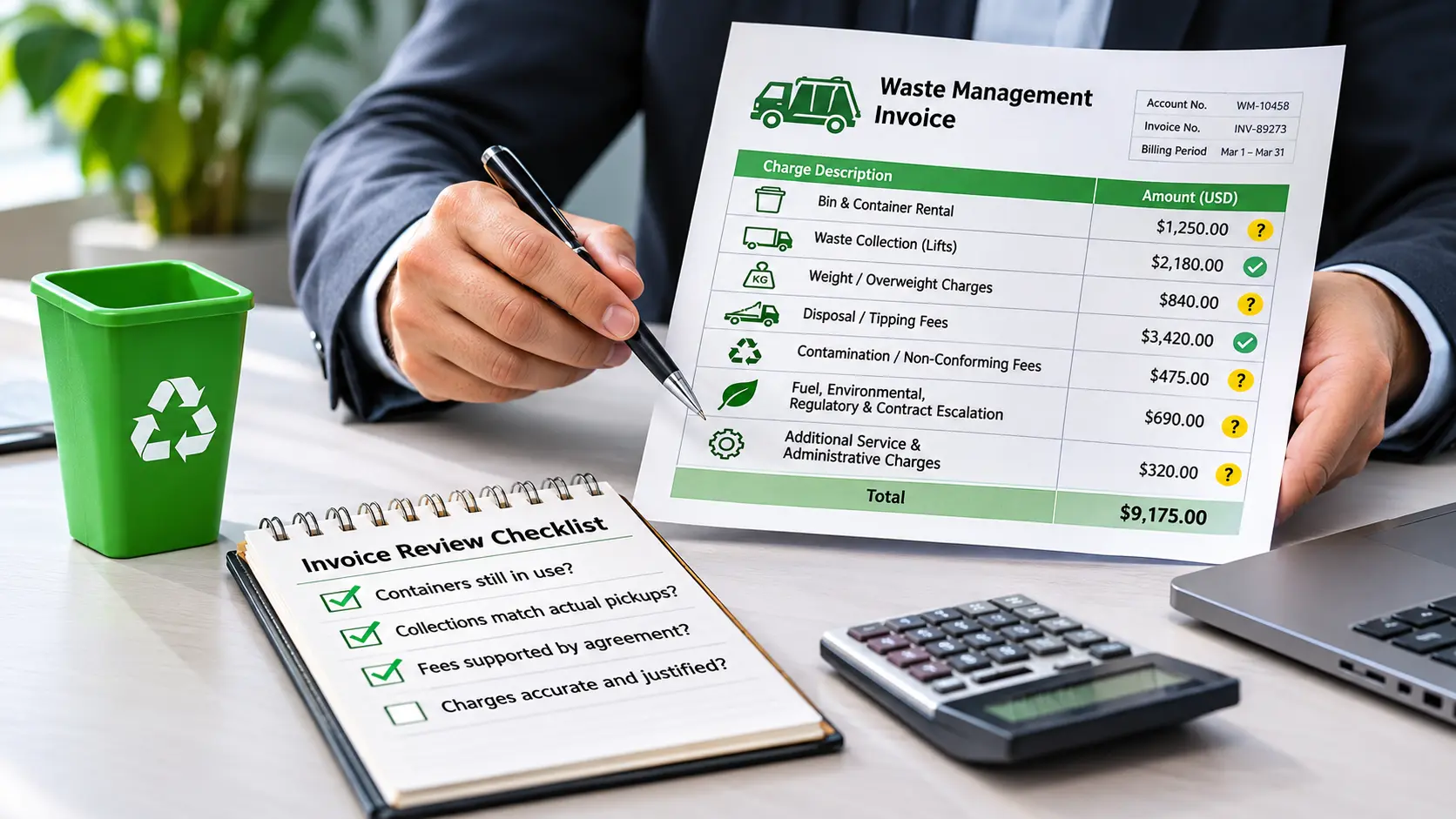
Identify hidden fees, unnecessary service charges, and contract-related increases that can inflate your business’s waste management costs.
A waste management invoice can appear routine while hidden discrepancies increase costs across facilities. A manufacturer may be paying rent for removed containers, being billed for missed collections, or facing surcharges that do not match its contract. When repeated across sites and billing cycles, these charges can increase operating expenses and make waste management costs harder to control.
For U.S. manufacturers managing multiple facilities, every charge should be checked against equipment records, actual services, documented weights, and contract terms. Classify charges as valid and contractually supported, incorrect or unsupported, or valid but worth renegotiating.
Retain supported charges, dispute those with missing evidence or calculation errors, and renegotiate recurring costs that are no longer commercially favourable. This approach helps identify genuine expense reduction opportunities without challenging legitimate fees.
The following seven charges provide a practical starting point for reviewing invoices, validating waste management costs, and identifying potential savings.
- Bin and container rental charges
- Waste collection and lift charges
- Weight and overweight charges
- Disposal fees and tipping charges
- Contamination and non-conforming waste fees
- Fuel, environmental, regulatory, and contract escalation charges
- Additional service and administrative charges
1. Bin and Container Rental Charges
What factors affect commercial waste collection costs?
Commercial waste collection pricing typically reflects several variables: container size and quantity, waste type, collection frequency, weight, site location and access, disposal arrangements, and contract terms. Therefore, a business’s waste management cost depends on the full service configuration, not one invoice rate.
What It Is
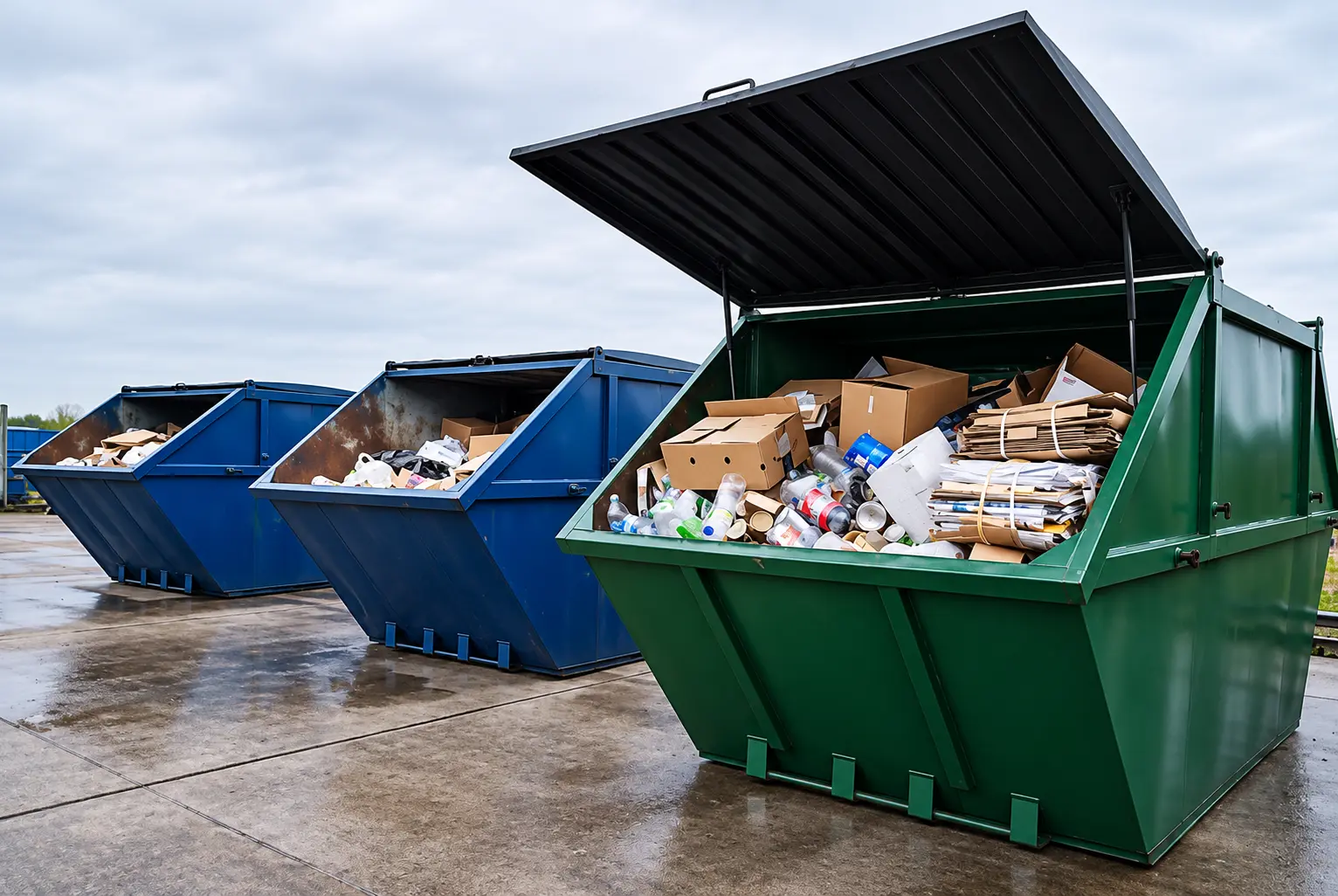
Waste haulers may charge recurring rental fees for dumpsters, front-load containers, roll-off boxes, compactors and other equipment placed at a facility. These charges are generally separate from collection and disposal fees and may depend on container size, quantity, equipment type and the terms of the service agreement. Together, these recurring fees contribute to the facility’s overall waste management cost.
A higher rental rate does not automatically indicate an overcharge. The concern is whether the business is paying for equipment it no longer needs, a larger capacity than its waste volume requires, or a rate that has changed without the adjustment being supported by the contract.
Reviewing these details is particularly important when multiple facilities have different equipment inventories and agreements, as inconsistencies can make the total waste management cost harder to control.
Why It Matters
- Excess capacity: A facility may be paying for larger containers than its typical waste volume requires. Reviewing container utilization can reveal opportunities for expense reduction without affecting required service levels.
- Unnecessary equipment: Containers may remain on-site after a facility, production line or service requirement has changed.
- Incorrect inventory: Invoices may include equipment that has been removed, replaced or is not present at the location.
- Unverified rate increases: Rental rates may change without a corresponding contractual provision or documented amendment.
Pro Tip
Reconcile the hauler’s equipment list with a physical inventory at each facility. Record each container’s type, size, location, asset ID (where available), and service status. Check delivery, exchange, and removal dates against invoice rental periods to identify equipment charges no longer on site.
Before requesting container changes, compare capacity with fill levels across several collection cycles. Use this evidence to negotiate adjustments where equipment exceeds operational needs. This supports expense reduction while ensuring the recurring waste management cost reflects the containers actually on site and required.
2. Waste Collection and Lift Charges
What It Is
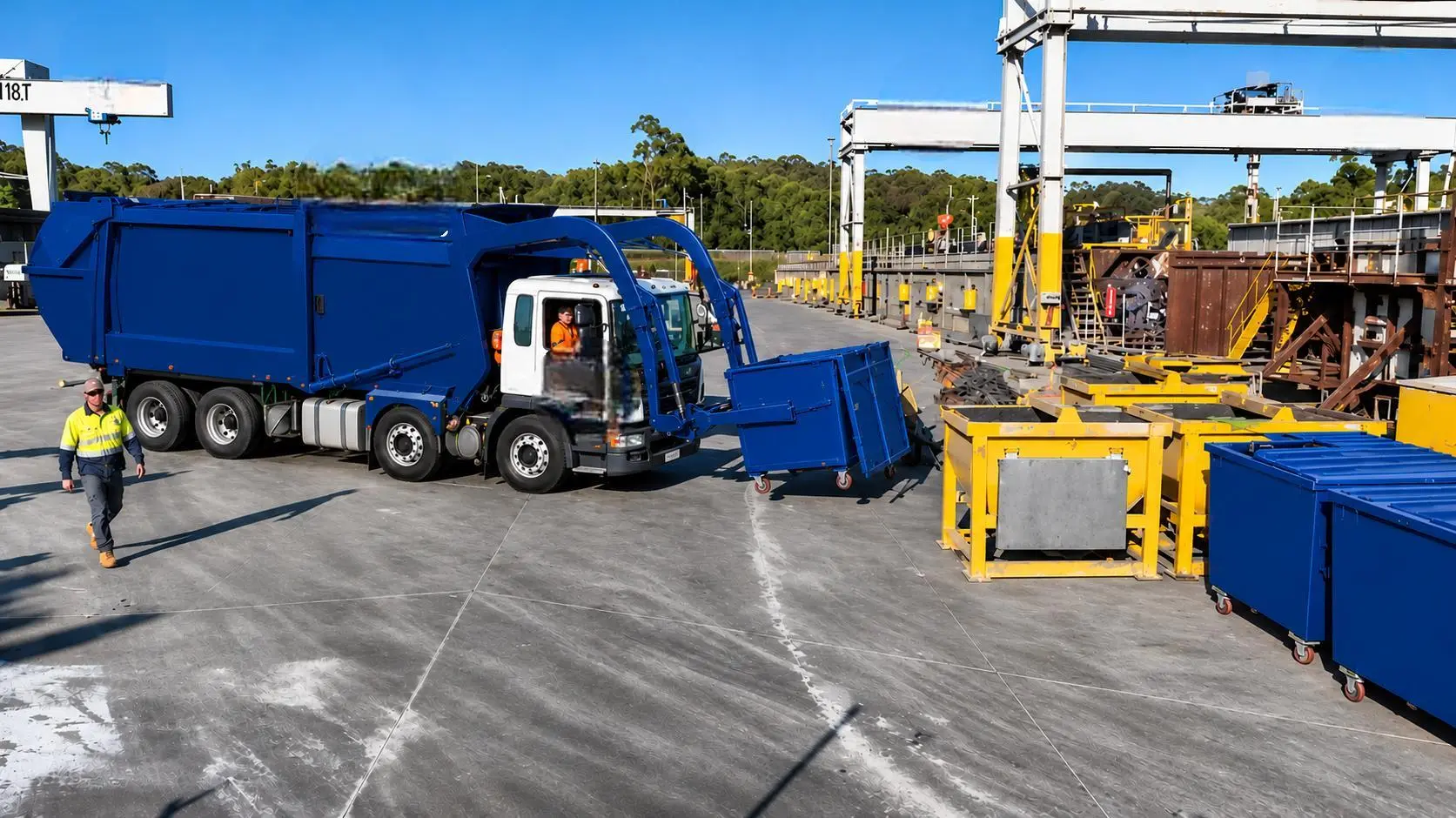
Collection and lift charges cover the service of picking up and emptying waste containers. Depending on the agreement, the hauler may bill a recurring collection fee, a per-lift rate or a combination of the two. Pricing can vary by container type, collection frequency, service location and agreed schedule. These service fees form a recurring part of the facility’s waste management cost.
These charges are distinct from container rental: rental covers the equipment, while collection charges cover the work required to service it. A facility may therefore have a reasonable rental rate but still incur an unnecessarily high waste management cost if its collection schedule does not reflect actual waste generation. The key is to establish whether the number of scheduled lifts matches operational needs and whether the invoice reflects the service actually performed.
Why It Matters
- Unnecessary pickups: Containers may be collected while they are still substantially empty. Adjusting collection frequency to match actual waste generation can support expense reduction.
- Excess lift charges: Additional lifts may be billed even when they were not requested or supported by service records.
- Billing discrepancies: Invoices may show completed collections that do not match pickup records, facility logs or documented missed services.
- Outdated schedules: Production changes, seasonal slowdowns and facility closures may make the original collection frequency inappropriate.
Real-World Example
Midland Farms, a dairy processing, pasteurizing and distribution company, engaged The SALT Group to review several operating expense categories, including waste.
The review identified an opportunity to manage waste through fewer hauls while transporting more tons. The engagement also resulted in improved agreements and terms for waste and utility services. Across waste, Sales & Use Tax and utility expenses, the review identified $254,592.12 in savings. The engagement took approximately one year, with only a few hours of client involvement reported.
This example demonstrates how reviewing collection arrangements alongside other operating expenses can uncover expense reduction opportunities improve service agreements, and lower costs. The reported amount represents combined savings across these three categories, rather than waste savings alone.
Pro Tip
Build a pickup exception log recording each scheduled service day, actual pickup date, missed or delayed collections, extra lifts, and who authorised them. Match billed lifts against this log and the hauler’s service records to identify missed collections, unrequested lifts, or charges assigned to the wrong facility.
Review container fill levels and production patterns over several weeks, including seasonal changes and shutdowns, before adjusting collection frequency. Use the findings to negotiate a revised schedule and rate, aligning recurring service charges with actual waste generation without compromising operational capacity.
3. Weight and Overweight Charges
What It Is
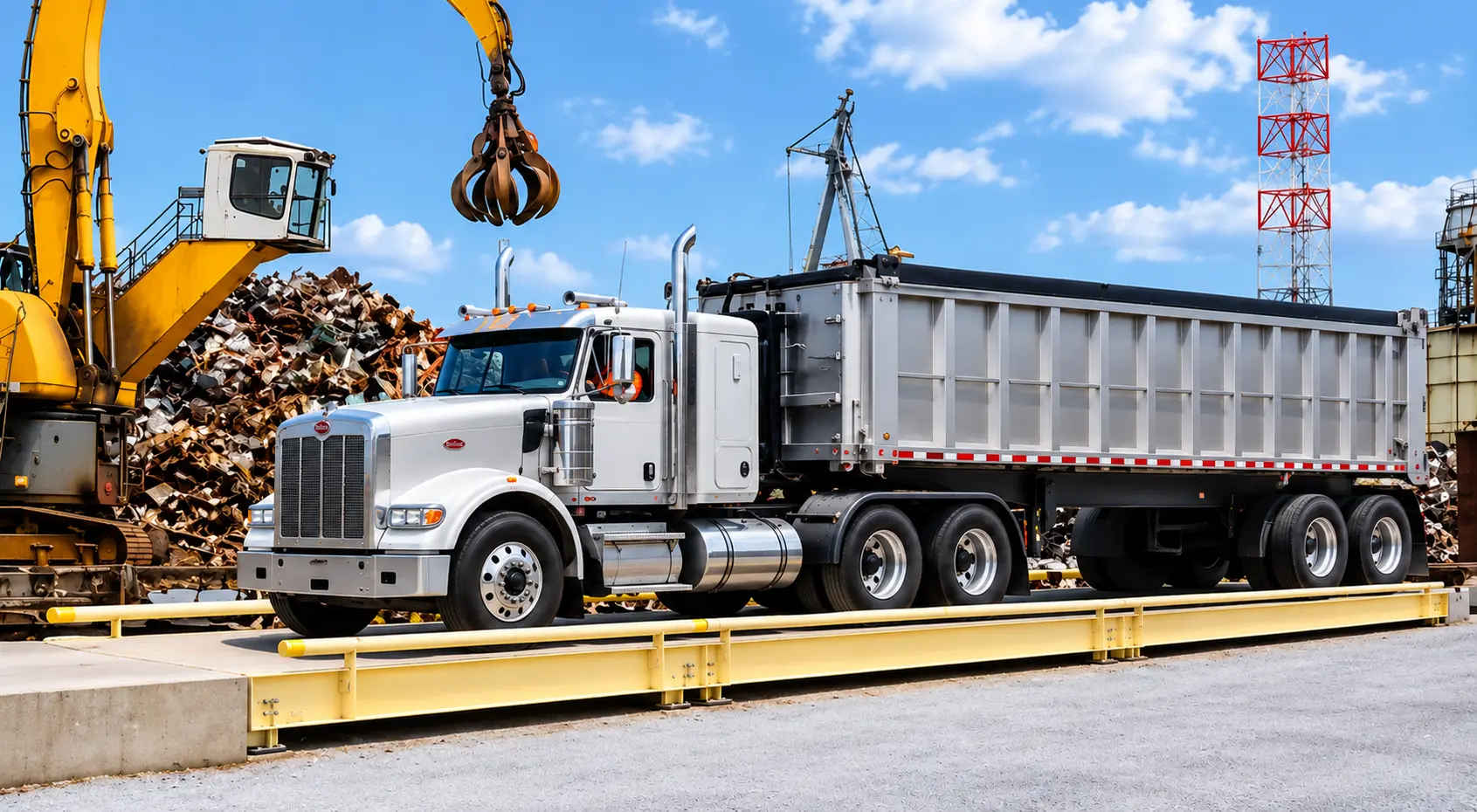
Some waste agreements include a permitted weight allowance for each collection, container or billing period. When the recorded weight exceeds that allowance, the hauler may apply an overweight or excess-tonnage fee. The charge may be calculated per additional ton, pound or another unit specified in the contract.
This is particularly relevant to manufacturers handling dense materials, production residue, scrap and other heavy waste streams. However, the presence of an overweight fee on an invoice does not establish that the amount is correct. The billed weight, applicable allowance, measurement unit and excess rate must all agree with the contractual terms. Errors in any of these elements can inflate the waste management cost.
Why It Matters
- Unsupported weights: An invoice may show a billed tonnage without an accompanying scale ticket or other acceptable weight record. Without this evidence, the business cannot reliably validate the charge or identify potential expense reduction opportunities.
- Incorrect allowances: The hauler may apply a lower weight allowance than the one agreed in the contract.
- Calculation errors: Excess tonnage may be charged at the wrong rate, or the permitted allowance may be deducted incorrectly.
- Recurring overages: Repeated overweight fees may indicate that the agreed container or pricing arrangement no longer reflects the facility’s waste profile.
Pro Tip
Recalculate each overweight fee using the recorded weight, permitted container allowance, agreed billing unit, and contractual excess rate. Subtract the allowance from the net weight and apply the agreed rate, including any rounding rules. Keep the scale ticket and calculation for verification.
For example, a 2.4-ton load with a 2-ton allowance and a $30-per-ton excess rate results in a $12 charge. Confirm the terms before approving the fee.
If overages recur, review container sizing and contractual allowances to identify expense reduction opportunities and ensure waste management cost reflects documented weights and agreed rates.
What should businesses do if they repeatedly incur overweight charges?
Repeated overweight charges may indicate that a container’s capacity, permitted weight allowance or pricing arrangement no longer reflects the facility’s waste profile. Review weight records across several collection cycles to establish whether the overages are consistent. If they are, assess whether a different container configuration, revised weight allowance or updated contract terms would better suit the facility’s requirements. This can support expense reduction while keeping waste management costs aligned with actual operating needs.
4. Disposal Fees and Tipping Charges

What It Is
Disposal or tipping fees are charges associated with delivering waste to a landfill, transfer station or other permitted disposal facility. Depending on the agreement, these waste management costs may be incorporated into the hauler’s base service rate or passed through to the customer as separate line items. The amount can vary according to waste type, disposal facility, measured weight and the applicable pricing arrangement.
A separately itemized disposal fee is not automatically an additional or improper charge. The important question is whether the agreement permits it, how it is calculated and whether it duplicates a cost already included in the collection rate. Without that distinction, businesses may struggle to determine whether their waste management cost reflects the agreed pricing structure.
Why It Matters
- Unexplained increases: Disposal rates may rise without a clear explanation of the effective date or applicable pricing change.
- Duplicate billing: A disposal component may be charged separately even though the agreed service rate already includes it. Identifying these overlaps can create opportunities for expense reduction.
- Incorrect pass-throughs: The billed amount may not reconcile with the applicable facility rate, weight or contractual calculation.
- Unclear waste classification: Different waste streams may carry different disposal rates, making accurate classification important.
Pro Tip
Start by identifying how the contract prices disposal: included in the base collection rate, charged as a separate pass-through, or handled through another stated method. Create a simple rate map for each service agreement showing the base rate, disposal component, waste stream, and any separate tipping line. This makes it easier to spot when a disposal amount may already be embedded in the contracted service price.
For pass-through arrangements, compare the billed rate and tonnage with the applicable facility rate and supporting disposal record, allowing for any contractually permitted handling or markup. Use comparable waste streams and facilities when benchmarking.
This review can support expense reduction by identifying duplicated or incorrectly calculated disposal charges without assuming that every separate fee is improper.
5. Contamination and Non-Conforming Waste Fees
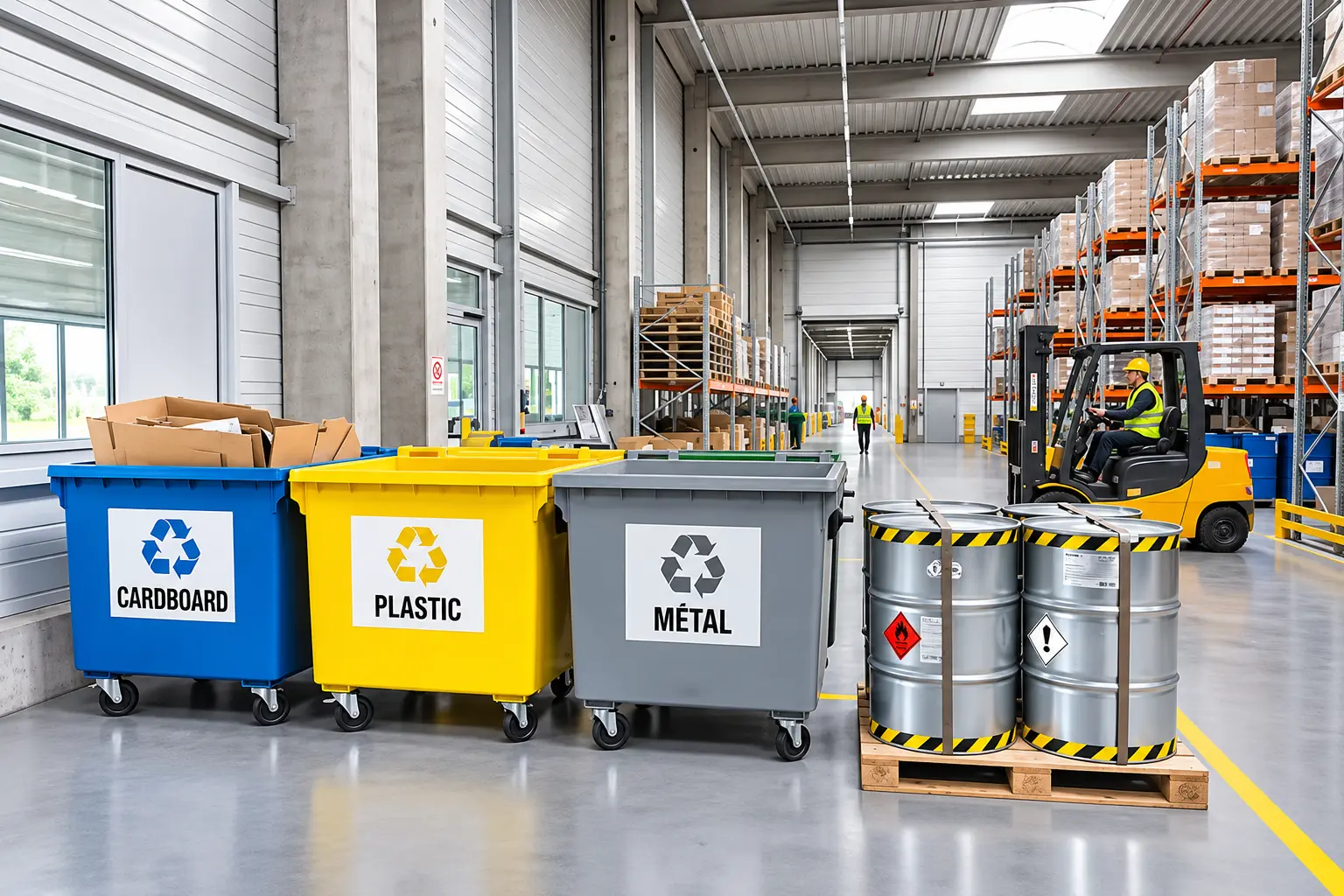
What It Is
Haulers may apply contamination or non-conforming waste fees when the contents of a container do not meet the waste acceptance requirements specified in the service agreement. Examples may include prohibited materials in a designated waste stream, unacceptable levels of contamination in recyclable loads, or materials that require different handling or disposal. These penalties, when applied, can add to a facility’s waste management cost.
These fees can be legitimate when the agreement defines the relevant conditions and the hauler can substantiate the incident. However, a charge should not be accepted solely because it is labelled as a contamination penalty. The business needs to establish what material was identified, which contractual requirement applied and how the fee was calculated. Incorrect classifications or unsupported penalties can unnecessarily increase the overall waste management cost.
Why It Matters
- Unsubstantiated fees: Charges may appear without inspection reports, photographs or other evidence identifying the non-conforming material. Reviewing the supporting records can help businesses identify expense reduction opportunities.
- Incorrect classification: A load may be assigned to a higher-cost waste category without sufficient justification.
- Repeated penalties: Similar charges may recur even when the underlying incident has not been verified or the relevant service issue has been addressed.
- Contractual inconsistencies: The fee may not match the definitions, notification requirements or penalty provisions in the agreement.
Pro Tip
Create an incident-level record for every contamination or non-conforming waste fee. The record should identify the collection date, facility, container, waste stream, material cited and the hauler’s evidence, such as inspection notes or photographs. Match that evidence to the contract’s acceptance criteria and notification requirements. A photograph without a clear link to the billed container or service date may not be enough to substantiate the particular charge.
Track repeat incidents by location and material rather than treating each penalty in isolation. That can show whether a classification is being applied consistently or whether the same event has been billed more than once.
Resolving unsupported or misclassified fees can support ongoing expense reduction by preventing inaccurate penalties from becoming recurring charges.
6. Fuel, Environmental, Regulatory, and Contract Escalation Charges

What It Is
Waste haulers may apply fuel, environmental, or regulatory surcharges to account for specified operating or compliance-related costs .These charges generally fall into two categories: variable pass-through charges and contractual rate escalators. Each should be reviewed separately because the supporting terms, calculations, and effective dates may differ.
- Variable pass-through charges: These are separately identified charges intended to recover specified costs, such as fuel, environmental, or regulatory expenses. Check the contract for the permitted charge, its calculation basis, any supporting documentation, and the conditions under which it can change.
- Contractual rate escalators: These adjust the underlying service rate according to an agreed provision, such as a scheduled annual increase or an index-based formula. Verify the applicable formula, cap, effective date, and notice requirements. Either mechanism may be legitimate, but unclear or overlapping adjustments can increase the waste management cost beyond what the business expected.
Why It Matters
- Unverified increases: A variable surcharge may be applied without the contractual basis or supporting documentation, while an escalator may take effect without the required trigger or notice.
- Calculation discrepancies: The surcharge calculation, escalator percentage, base rate, or effective date may not match the applicable contractual terms.
- Overlapping charges: A cost component may already be included in the base service rate but also appear as a separate pass-through charge.
- Automatic escalation: Contractual rate increases may continue even when the business has not reviewed the overall pricing arrangement or current service requirements.
Pro Tip
Maintain a waste management cost register for every facility, separating variable pass-through charges from contractual rate escalators. For each pass-through charge, record the contractual basis, cost component, calculation method, supporting documentation, effective date, and any applicable cap.
For each escalator, record the relevant clause, adjustment formula, base rate, effective date, notice requirement, and cap. Recalculate both using their respective contractual provisions and check whether the same cost component is already included elsewhere. This is especially important when a base-rate increase and a separate surcharge take effect in the same billing period.
Use the register to compare changes across sites and flag adjustments that lack the required contractual basis, calculation, or notice. A documented review can support expense reduction through billing corrections and contract renegotiations while keeping recurring charges aligned with the agreement’s actual adjustment provisions.
When should a business review its waste collection contract?
contract before renewal and whenever production volumes, facility use, operating hours or waste streams change. These shifts can make existing service terms unsuitable. Regular reviews support expense reduction by keeping pricing and collection arrangements aligned with current operating requirements.
7. Additional Service and Administrative Charges
What It Is
Additional service and administrative charges cover work or activities outside the standard collection and rental arrangement. Depending on the agreement, these may include extra pickups, container delivery or relocation, cleaning or dig-out services, return trips, overfill charges, missed-collection fees and minimum service or administrative charges. These items can add to a facility’s overall waste management cost, particularly when they appear regularly across invoices.
Some of these fees are appropriate when a service has been requested, performed and priced according to the contract. The issue is whether the business authorized the work, received the service and was billed at the agreed rate. Miscellaneous line items can be difficult to track across multiple facilities, making them a potential source of avoidable waste management costs.
Why It Matters
- Unrequested services: Extra pickups or equipment movements may be billed without a corresponding request or authorization. Checking these charges can reveal opportunities for expense reduction.
- Duplicate charges: The same service event may appear more than once or be included in another billed item.
- Uncompleted work: A return trip, cleaning service, or other additional activity may be charged without evidence that it took place.
- Unclear fee provisions: Administrative or minimum charges may be applied without a clear contractual basis or agreed calculation.
Pro Tip
Require every non-routine charge to carry a service reference. Match each additional pickup, container move, return trip, cleaning, dig-out or other billable activity to a work order or service request showing who authorized it, when it was performed, which facility and container were involved, and the agreed rate. Check completion records before approving payment; a request alone does not establish that the work was carried out. Also compare repeat entries against the same work order to catch duplicate billing.
For recurring additional services, review whether the activity is genuinely exceptional or has become part of normal site operations. That distinction can inform a clearer service schedule or pricing arrangement.
It can also support expense reduction by ensuring that recurring waste service expenses include only authorized, completed, and correctly priced work.
Find More Opportunities to Reduce Waste Management Costs and More
Explore how a structured review of existing business expenses can uncover hidden overpayments and ongoing savings.

Review Waste Charges to Keep Management Costs Under Control
Identifying potentially unnecessary charges is only the first step. Manufacturers need a consistent process to determine whether billed amounts are supported by service records, permitted under the contract, and aligned with actual facility requirements.
Use the following checks when reviewing commercial waste invoices and agreements:
- Verify supporting records: Match billed services, weights and additional fees with pickup logs, scale tickets, work orders and other supporting documentation.
- Check contract terms: Confirm that rental rates, weight allowances, disposal fees, surcharges and escalation provisions match the applicable agreement.
- Compare facility requirements: Assess container capacity, collection frequency and service arrangements against actual waste generation and operating schedules.
- Investigate recurring discrepancies: Track repeated billing errors, unsupported fees and unexplained increases across facilities and billing cycles.
- Document corrective actions: Record disputed charges, agreed billing corrections, rate adjustments and vendor follow-ups to support ongoing expense reduction.
A consistent review process helps manufacturers distinguish between charges to retain, charges to dispute, and recurring waste management costs worth renegotiating. This creates a structured approach to expense reduction across facilities.
This can identify eligible historical overpayments and expense reduction opportunities while ensuring that waste management costs reflect the services received and the terms agreed with each hauler.
How should businesses compare commercial waste management costs?
Businesses should compare waste management costs using the same container sizes, waste streams, collection frequency, weight allowances and service terms. They should also account for disposal fees and additional charges. A like-for-like comparison supports expense reduction by revealing the actual cost of each proposed service.
Reduce Unnecessary Waste Management Costs Through a Smarter Expense Reduction Strategy
Commercial waste invoices can include inaccurate weights, unsupported penalties, duplicated disposal charges, and unexplained price adjustments. Without regular waste management cost checks against service and contract records, these discrepancies can inflate recurring waste management costs. A focused expense reduction review helps distinguish valid charges from historical overpayments and costs that warrant correction or renegotiation.
The SALT Group reviews both historical and ongoing expenses Invoice validation can identify eligible historical overpayments for recovery, while contract assessments, service-level reviews, localized market benchmarking, and vendor negotiations can uncover expense reduction opportunities. These waste management cost reviews help determine whether past invoices were billed correctly and whether current service arrangements and pricing reflect each facility’s requirements.
For manufacturers managing multiple facilities, The SALT Group’s waste specialists review invoices, service requirements and contract terms, benchmark pricing against local market conditions, and work directly with vendors to correct discrepancies and negotiate improvements. Its turnkey approach keeps the workload on internal Finance, Accounting and Procurement teams to a minimum.
The engagement is performance-based, with fees tied to identified and implemented benefits, such as corrected charges or completed service and contract updates. Billing may occur when those changes are completed, rather than after every future saving has appeared on an invoice.
Recovering eligible historical overpayments can return amounts previously paid in error, while correcting recurring charges and implementing improved contract terms can support ongoing expense reduction across billing cycles. Addressing both helps businesses protect margins while maintaining the waste collection services their facilities need.
See How Much You Could Save on Commercial Waste Costs.
Frequently Asked Questions
1. How do I know if I’m being overcharged for commercial waste collection?
A high invoice alone does not prove overcharging. Compare billed rates, pickup records, container rental terms and surcharges with your contract . Repeated unexplained increases, duplicate fees or mismatched service records warrant investigation. Benchmarking can also help assess whether your waste management cost is competitive.
2. Can I reduce my waste management costs without changing haulers?
Yes. Correcting billing errors, renegotiating rates, resizing containers or adjusting pickup frequency may lower costs without changing providers. These expense reduction measures can preserve service continuity. Consider switching only when the existing hauler cannot meet your operational or financial requirements.
3. How can I identify hidden waste management costs across multiple locations?
Consolidate invoice data across facilities and compare container rentals, collection frequencies, disposal fees and surcharges. Use a consistent review process to identify recurring discrepancies, compare vendor pricing and assess whether service arrangements remain appropriate for each location. This can uncover expense reduction opportunities and help keep waste management costs aligned with facility requirements.
Key Takeaways for Controlling Waste Management Costs
Reviewing commercial waste charges helps manufacturers identify billing errors, validate service costs, and uncover savings opportunities.
- Reconcile container inventories to identify rental charges for removed equipment.
- Match billed collections against pickup logs and service records.
- Verify recorded weights, contractual allowances, and excess-tonnage calculations.
- Check disposal fees, contamination penalties, and surcharge provisions.
- Benchmark recurring charges against actual facility needs and contract terms.
Want to identify opportunities to reduce your waste management costs?