

Identify hidden overpayments, recover eligible costs, and reduce recurring operating expenses with a focused review built around your business.
Request a Cost Recovery Review
Executive Summary
How do manufacturers identify hidden opportunities to recover operating costs?
Manufacturers identify hidden cost recovery opportunities by reviewing invoices, contracts, tax payments, shipping charges, waste services, facilities, and payment fees to uncover overpayments, unnecessary charges, and missed savings.
The pressure to control operating expenses is increasing. In the National Association of Manufacturers’ Q2 2026 survey, rising raw material costs remained a leading challenge for manufacturers, underscoring the continued pressure on manufacturing margins.
In ISM’s Spring 2026 forecast, manufacturers expected prices paid for raw materials to increase 14.1% in 2026, adding further pressure to manufacturing costs.
These pressures make it increasingly important for manufacturers to examine where money may already be leaking from everyday operating expenses. Cost recovery focuses on reclaiming money already overpaid; cost reduction lowers future expenses; and cost optimization ensures ongoing spending remains aligned with actual business needs.
This guide examines hidden opportunities across:
- Sales & Use Tax
- Waste management
- Freight & parcel
- Facilities and uniform services
- Merchant card processing
- Invoice and contract overpayments
By combining benchmarking, transaction reviews, contract analysis, and supplier comparisons, manufacturers can identify overhead costs that exceed what they should be paying and turn those findings into measurable savings.
Why Identifying Hidden Cost Recovery Opportunities Matters

For finance leaders, the concern isn’t simply how much the business spends; it is whether its operating expenses are higher than they should be. Hidden overpayments can remain buried in invoices, tax transactions, vendor contracts, shipping charges, and service fees for months or years.
Identifying these opportunities matters because it can:
- Protect Profit Margins Without Increasing Revenue: Recovering overpaid operating expenses can improve profitability without requiring additional sales, price increases, or broad budget cuts.
- Stop Recurring Cost Leakage: A small overcharge can become a significant expense when repeated across thousands of transactions, locations, or billing cycles.
- Recover Money Already Lost: Businesses may be able to recover overpaid Sales & Use Taxes, incorrect fees, billing errors, and other unnecessary overhead costs.
- Strengthen Vendor Negotiations: Current cost benchmarks show finance and procurement teams what they should be paying, creating stronger leverage when negotiating rates, contracts, and service levels.
- Find Savings Beyond Internal Capacity: Detailed reviews of invoices, contracts, tax treatment, and complex fee structures can require specialized expertise and time beyond normal finance and procurement responsibilities.
- Address Multiple Sources of Overspending: Hidden recovery opportunities can exist across major operating expenses, including Sales & Use Tax, waste, freight and parcel, facilities and uniform services, and merchant services.
The takeaway: You don’t necessarily need to spend less everywhere. You need to know where your operating expenses exceed what you should be paying and have a process for recovering those costs and controlling future overhead costs.
How It Works: The SALT Manufacturing Cost Recovery Framework
The SALT Manufacturing Cost Recovery Framework helps manufacturers uncover hidden overpayments within their operating expenses, recover eligible costs, reduce unnecessary overhead costs, and prevent future leakage.
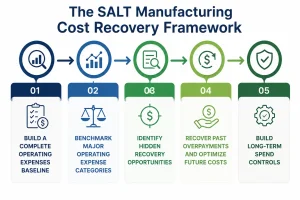
The framework follows five stages:
It starts by establishing where money is being spent, tests those costs against relevant benchmarks, identifies hidden recovery opportunities, converts findings into recoveries and ongoing savings, and establishes controls to protect those results.
1. Build a Complete Operating Expenses Baseline
What it is
Create a complete view of historical and current operating expenses across vendors, invoices, contracts, taxes, and services to establish where overpayments and unnecessary overhead costs may exist.
How to Implement
- Consolidate AP History: Compile 24–36 months of Accounts Payable records to identify recurring charges, unusual increases, historical payments, and patterns across major operating expenses.
- Connect ERP Data: Link purchasing and payment records with vendors, invoices, purchase orders, and spend categories to understand what was purchased, what was billed, and what was paid.
- Collect Vendor Records: Gather contracts, purchase orders, and service agreements to identify negotiated rates, renewal dates, escalators, service requirements, and terms affecting ongoing operating expenses.
- Organize Spend Records: Group tax records, freight invoices, waste bills, merchant statements, uniform records, and facility contracts so each overhead cost category can be examined systematically.
Pro Tip: Start with at least 24 months of history. Longer records make recurring billing errors, gradual price increases, and small overpayments easier to distinguish from normal expense fluctuations.
Once the spending picture is complete, the next step is determining whether those operating expenses are competitive, appropriate, and aligned with actual business requirements.
2. Benchmark Major Operating Expense Categories
What it is
Compare operating expenses against relevant market, industry, regional, contract, tax, and service benchmarks to determine whether current costs remain reasonable for the business.
How to Implement
- Establish Market Benchmarks: Compare vendor pricing with current market rates while accounting for volume, location, service scope, and contract terms.
- Compare Industry Costs: Evaluate major operating expenses against relevant industry benchmarks to identify unusual pricing or spending patterns.
- Analyze Regional Rates: Compare location-dependent expenses such as waste, facilities, and freight against regional pricing.
- Validate Contract Pricing: Check actual invoices against negotiated rates, discounts, escalators, service levels, and renewal terms.
- Measure Service Usage: Compare contracted services with actual utilization to identify capacity or service levels that no longer match business needs.
Pro Tip: Benchmark total delivered cost rather than the advertised rate. Fees, surcharges, escalators, and service levels can make an apparently competitive price significantly more expensive.
With benchmarks established, manufacturers can distinguish legitimate cost differences from operating expenses that contain recoverable overpayments or avoidable overhead costs.
3. Identify Hidden Recovery Opportunities
What it is
Examine operating expenses for historical overpayments, billing errors, unfavorable pricing, unused services, and discrepancies that may create recoverable savings or reduce ongoing overhead costs.
How to Implement
- Review Tax Payments: Analyze historical transactions for incorrectly charged taxes, missed exemptions, unused credits, and potential refund opportunities across applicable states and purchase categories.
- Audit Shipping Charges: Compare freight and parcel invoices against contracted rates, discounts, surcharges, accessorial charges, and shipment records to identify billing discrepancies and unnecessary expenses.
- Review Waste Services: Compare equipment, pickup frequency, contracted services, and additional fees against actual waste volumes and operational requirements to identify unnecessary ongoing costs.
- Analyze Merchant Fees: Examine merchant statements, transaction costs, interchange-related charges, and pricing structures to identify excessive processing expenses and potential savings.
- Review Facility Services: Examine facilities and uniform contracts for excessive service levels, pricing discrepancies, markups, escalators, and terms that no longer reflect current requirements.
Pro Tip: Don’t automatically dismiss small discrepancies. Track recurring charges by transaction volume and frequency; seemingly minor errors can become substantial recovery opportunities when repeated across locations.
After potential opportunities are identified, each finding must be validated and converted into an actionable financial outcome.
4. Recover Past Overpayments and Optimize Future Costs
What it is
Turn validated findings into financial results through refunds, credits, vendor negotiations, contract changes, and service adjustments that reduce past and future operating expenses.
How to Implement
- Negotiate Vendor Rates: Use benchmarks and purchasing data to negotiate better rates and remove unnecessary charges.
- Pursue Tax Recoveries: Submit eligible refund claims supported by transaction records, tax documentation, and applicable exemptions.
- Request Vendor Credits: Present confirmed billing discrepancies to vendors and pursue appropriate credits or adjustments.
- Renegotiate Contracts: Address unfavorable pricing, escalators, service terms, and renewal provisions before they increase future expenses.
- Right-Size Services: Adjust service frequency, equipment, capacity, or scope to match actual business requirements.
- Implement Approved Changes: Coordinate pricing, contract, service, and billing changes so identified savings are reflected in actual expenses.
Pro Tip: Treat every recovery as a root-cause review. A refund addresses the past; correcting the pricing, contract, service, or billing issue helps prevent the same expense from rising again.
Recovering past overpayments creates immediate value, but those savings can disappear if operating expenses are not monitored after the initial review.
5. Build Long-Term Spend Controls
What it is
Establish recurring controls that protect recovered savings, monitor changing vendor and contract conditions, and identify new operating expense leakage before it compounds.
How to Implement
- Schedule Regular Benchmarking: Reassess major vendor pricing annually and before significant renewals to identify new opportunities.
- Manage Contract Renewals: Track renewal dates, escalators, service requirements, and renegotiation windows.
- Use Vendor Scorecards: Measure vendors against pricing, billing accuracy, service levels, contract compliance, and operational performance.
- Validate Invoices: Establish recurring checks for duplicate charges, incorrect rates, unexpected fees, and other discrepancies.
- Track Cost Exceptions: Flag unusual price increases, billing anomalies, service changes, and other exceptions for investigation.
- Assign Category Ownership: Give specific teams or individuals responsibility for major operating expenses, vendor performance, renewals, and spend controls.
Pro Tip: Separate one-time recoveries from recurring savings when reporting results. This shows leadership what was recovered and what will continue improving profitability in future periods.
The SALT Manufacturing Cost Recovery Framework connects operating expense visibility, benchmarking, identification, recovery, optimization, and ongoing controls to turn hidden cost leakage into measurable financial results.
With the framework established, the next section looks at the operating expense categories where manufacturers are most likely to uncover hidden recovery opportunities.
Real-World Manufacturing Cost Recovery: What Works and What Doesn’t

Hidden operating cost opportunities rarely look the same from one manufacturer to another. The examples below show how pricing, service levels, contracts, billing, and tax treatment can create recurring leakage, and how targeted reviews can uncover it.
Bad Example: Assuming Negotiated Rates Mean Costs Are Optimized
Hypothetical scenario: A manufacturer assumed its negotiated vendor rates were already competitive.
- What we found: A review of historical invoices against contracts uncovered outdated pricing, freight surcharges, and unnecessary waste and facility services.
- Why it continued: No one was regularly comparing actual charges with current benchmarks and service requirements.
- The impact: Small recurring discrepancies accumulated, quietly increasing operating expenses.
The lesson: A negotiated contract does not guarantee optimized costs. Regular benchmarking and invoice reviews can uncover leakage that routine AP checks miss.
Good Example: Finding $1.3M in Automotive Manufacturing Savings
At Newman Technology, an automotive-parts manufacturer with approximately 1,187 employees and $403 million in annual sales, we reviewed several operating expense categories.
- What we reviewed: Waste, uniform and facility services, merchant card processing, parcel, and freight.
- What we identified: $1,327,307.12 in savings, including recurring savings opportunities.
- What mattered: The opportunity was spread across multiple everyday expense categories rather than coming from one isolated billing issue.
The review demonstrated how examining operating expenses across categories can uncover substantial savings even when established vendors and purchasing processes are already in place.
Good Example: Turning Multiple Cost Leaks Into $254K in Savings
At Midland Farms, a dairy processing and distribution company generating approximately $20 million in annual revenue, the review uncovered opportunities across several operating expenses.
- Waste: Fewer hauls while handling more tons reduced unnecessary service costs.
- Utilities: A new vendor agreement secured a fixed rate and approximately $5,000 in monthly savings.
- Sales & Use Tax: Tax paid incorrectly on electricity created a significant recovery opportunity.
- Total identified: $254,592.12 across waste, Sales & Use Tax, and utility expenses.
The outcome went beyond the initial recovery, producing refunds, recurring savings, and improved waste and utility agreements, with only a few hours of client involvement.
These examples show why manufacturers should look beyond individual invoices and examine patterns across operating expenses. Small discrepancies, outdated agreements, and misaligned services can collectively create meaningful recovery opportunities.
Next, we’ll examine the specific operating expense categories where manufacturers should look first for hidden overpayments and overhead costs.
Best Practices for Identifying Hidden Operating Costs

Finding recoverable costs requires more than checking whether invoices were paid correctly. Manufacturers need to test pricing, contracts, service levels, utilization, and historical spend to uncover recurring leakage.
Use these Pro Tips when reviewing operating expenses:
- Pro Tip: Benchmark Total Cost
Compare base rates plus surcharges, escalators, accessorial fees, and service charges to reveal the true cost. - Pro Tip: Test Contract Compliance
Match invoices against negotiated rates, discounts, escalators, service levels, and renewal terms to catch billing discrepancies. - Pro Tip: Compare Cost to Usage
Match contracted service levels with actual volumes to identify unnecessary pickups, capacity, frequency, or unused services. - Pro Tip: Review Transaction-Level Data
Analyze individual invoices and transactions to uncover recurring errors that disappear within aggregate monthly spend. - Pro Tip: Consolidate Multi-Location Spend
Combine comparable spend across facilities to expose inconsistent vendor pricing and strengthen negotiating leverage. - Pro Tip: Analyze Historical Spend
Review 24–36 months of data to identify recurring overpayments, gradual price increases, and persistent billing patterns. - Pro Tip: Investigate Root Causes
Determine whether leakage originates from vendor billing, contract terms, tax treatment, pricing, or service requirements. - Pro Tip: Separate Recovery From Savings
Report historical recoveries separately from recurring reductions so leadership can measure immediate and ongoing financial impact. - Pro Tip: Review Before Renewal
Start benchmarking before renewal windows to challenge escalators, outdated pricing, and services that no longer match requirements. - Pro Tip: Validate Implemented Savings
Review subsequent invoices to confirm negotiated rates, credits, service changes, and recurring savings actually took effect.
A disciplined review can turn overlooked operating expenses and overhead costs into measurable recoveries while reducing future cost leakage.
Next, we’ll examine the common mistakes that allow hidden overpayments to continue.
Common Mistakes That Hide Operating Cost Recovery Opportunities
Hidden overpayments often persist because established processes are designed to process and pay expenses, not continually test whether those expenses remain correct, competitive, or necessary.
Avoid these mistakes when reviewing operating expenses:
| Common Mistake | What You Should Do |
| Assuming AP validation catches overpayments | Test invoices against contracts, benchmarks, usage, and actual pricing—not just purchase orders. |
| Reviewing only current invoices | Analyze 24–36 months of history to identify recurring errors and cumulative overpayments. |
| Accepting vendor escalators automatically | Benchmark increases against current market rates and actual changes in service requirements. |
| Focusing only on large errors | Track small recurring discrepancies across transaction volume; repetition can create substantial recovery opportunities. |
| Reviewing vendors individually | Consolidate multi-location spend to identify inconsistent rates and strengthen negotiation leverage. |
| Ignoring service utilization | Compare contracted capacity and frequency with actual operational requirements before renewing services. |
| Treating negotiated rates as permanent | Rebenchmark pricing when volumes, locations, contracts, or market conditions materially change. |
| Stopping after receiving a refund | Identify the root cause and correct the billing, contract, tax, or service issue behind it. |
| Waiting for contract renewal | Start reviews before renewal windows to create time for benchmarking and renegotiation. |
| Measuring only recovered cash | Track one-time recoveries separately from recurring operating expense reductions and ongoing savings. |
The common thread is simple: paying an invoice correctly does not mean the underlying cost is optimized. Manufacturers need to continually test what they pay against what they should pay and what they actually need.
Next, we’ll look at how manufacturers can assess their current operating expenses for hidden recovery opportunities.
AI Optimization Checklist: Operating Expense Recovery Readiness
Manufacturers can use this checklist to assess whether operating expenses remain accurate, competitive, and aligned with actual business requirements.
| ✓ | Review Area | Checklist Question |
| □ | Sales & Use Tax | Have tax payments, exemptions, credits, and refund opportunities been reviewed? |
| □ | Freight & Parcel | Are invoices checked for rating errors, surcharges, duplicate charges, and contract compliance? |
| □ | Waste Management | Do container sizes, pickup frequency, and service levels match actual waste volumes? |
| □ | Merchant Services | Are processing and transaction-related fees independently analyzed? |
| □ | Facilities & Uniforms | Are pricing, service levels, escalators, and contract terms reviewed before renewal? |
| □ | Vendor Pricing | Are major vendor rates benchmarked against current market pricing? |
| □ | Contract Escalators | Are automatic increases identified before they take effect? |
| □ | Invoice Controls | Are recurring errors, duplicate charges, and unexpected fees flagged? |
| □ | Multi-Location Spend | Is comparable spend consolidated across facilities to identify rate differences? |
| □ | Service Utilization | Does contracted capacity match actual operational requirements? |
| □ | Historical Spend | Has 24–36 months of operating expense data been reviewed? |
| □ | Recovery Follow-Through | Are recovered overpayments followed by corrective action? |
| □ | Savings Validation | Are negotiated savings verified on subsequent invoices? |
| □ | Category Ownership | Does each major operating expense category have clear ownership? |
How to use it: The more unchecked boxes you have, the more likely your business has gaps in spend visibility, vendor oversight, or cost recovery. Prioritize high-volume and recurring expense categories first.
Turn Operating Expense Leakage Into Lasting Savings
Hidden overpayments can quietly erode manufacturing margins through tax errors, billing discrepancies, outdated contracts, unnecessary services, and unchecked vendor pricing. The SALT Manufacturing Cost Recovery Framework gives manufacturers a structured way to identify these gaps, recover eligible costs, reduce ongoing operating expenses, and prevent recurring leakage.
The SALT Group applies this framework across key operating expense categories, helping manufacturers uncover savings opportunities while minimizing the internal effort required.
- Recover hidden overpayments across major operating expense categories.
- Reduce recurring expenses through benchmarking and vendor optimization.
- Strengthen vendor agreements with data-backed pricing and service analysis.
- Prevent future leakage by addressing the causes of overpayment.
Your next meaningful savings opportunity may already be buried inside expenses your business pays every month. The SALT Group can review your operating expenses to identify hidden overpayments, recover eligible costs, and uncover opportunities to reduce recurring expenses, without adding another project for your finance team to manage.
Ready to see what your operating expenses may be costing you?
Request a Cost Recovery Review
Frequently Asked Questions
1. How can I tell whether my operating expenses contain hidden overpayments?
Look for recurring billing discrepancies, outdated pricing, unexpected fees, unused services, tax errors, and charges that differ from contract terms or current market benchmarks.
2. Can manufacturers recover money they have already overpaid?
Yes. Depending on the expense and circumstances, reviews can uncover eligible tax refunds, vendor credits, billing corrections, and other recoverable costs.
3. Will reviewing overhead costs require significant time from my finance team?
Not necessarily. The SALT Group handles the detailed review and analysis, while the client primarily provides access to relevant financial and vendor records.
4. What if my procurement team already reviews vendor pricing?
A routine procurement review may not examine historical transactions, tax treatment, invoice-level discrepancies, or specialized fee structures. An independent review can uncover opportunities outside normal procurement processes.
5. How does cost recovery differ from reducing operating expenses?
Cost recovery focuses on reclaiming money already overpaid. Cost reduction lowers future expenses through pricing, contract, or service changes. Both can improve margins and reduce recurring overhead costs.
6. What is the difference between cost recovery, cost reduction, and cost optimization?
Cost recovery focuses on reclaiming money already overpaid. Cost reduction lowers future expenses through pricing, contract, or service changes. Cost optimization keeps ongoing spending aligned with actual business needs. A comprehensive review can address all three.
Related Guides
- The Complete Guide to Manufacturing Cost Reduction and Cost Recovery
- 5 Hidden Operating Cost Overpayments That Undermine Manufacturing Cost Reduction
- How Cost Reduction Consulting Can Benchmark Operating Costs and Identify Hidden Overpayments
- The Complete Guide to Recovering Hidden Operating Cost Overpayments and Optimizing Future Spend
- The Complete Guide to Business Spend Control for Stronger Profit Margins