
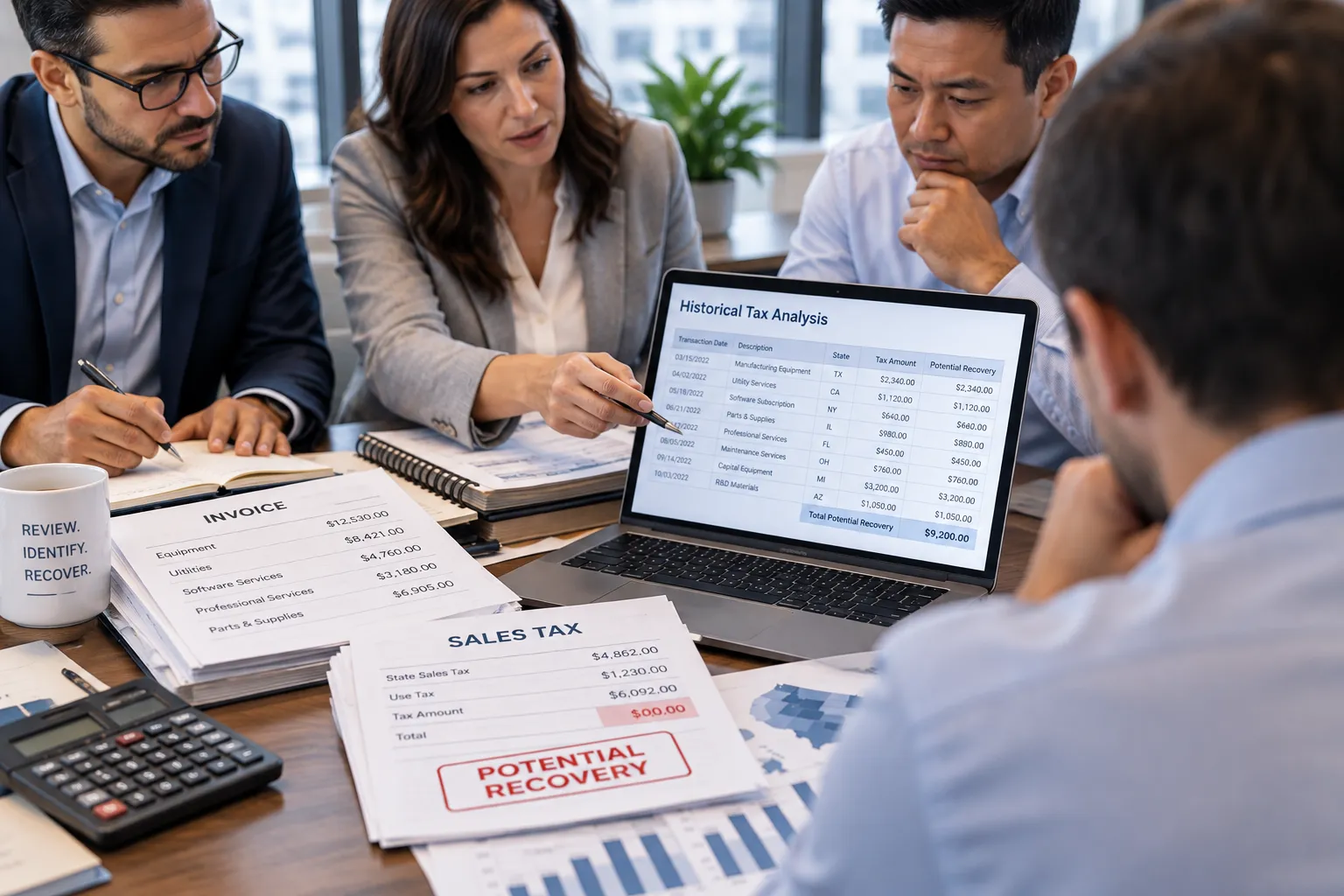
Find out how cost recovery consultants help finance teams uncover overlooked sales tax recovery opportunities.
What if your company is paying the right amount of Sales & Use Tax today, but still leaving significant money behind in yesterday’s transactions?
That possibility is easy to overlook when finance teams are already focused on revenue, margins, working capital, cash flow, and day-to-day compliance. Deloitte’s 2026 Global Tax Policy Survey reported that 40% of surveyed tax and finance leaders identified rising tax compliance burdens as a major business concern. As tax teams manage changing rules and growing workloads, historical transaction reviews can fall down the priority list.
A sales tax recovery review can uncover overpaid tax in historical AP transactions, even when current compliance processes are working as intended. Missed exemptions, incorrect vendor charges, outdated tax configurations, and recurring taxability errors can all contribute to these overpayments.
For manufacturers and multi-state businesses, these issues can span thousands of transactions and multiple jurisdictions. Here are five areas where cost recovery consultants can help finance teams uncover potential tax overpayments:
- Manufacturing machinery and R&D exemptions
- Hidden utility tax overpayments
- Outdated ERP tax engine configurations
- Vendor billing and double taxation errors
- Unmonitored software and SaaS taxability
1. Manufacturing Machinery and R&D Exemptions

What it is
Certain manufacturing machinery, production equipment, repair parts, components, and qualifying R&D purchases may receive exempt or preferential Sales & Use Tax treatment, depending on the state, the item purchased, and how it is used.
These exemptions are not blanket benefits for manufacturers. Eligibility typically depends on factors such as what was purchased, where it was used, and whether it was directly involved in qualifying production or R&D activities.
For finance teams reviewing historical transactions, the analysis should go beyond identifying the type of purchase. It should determine whether the asset or material was used in a qualifying activity, whether the applicable exemption existed in that jurisdiction at the time of purchase, and whether the required exemption documentation was available.
For manufacturers with high-value CapEx and R&D spending across multiple facilities, even small tax overpayments on individual transactions can become material when they recur across hundreds or thousands of purchases. This transaction-level review is central to identifying potential sales tax recovery opportunities.
Manufacturing purchases can therefore be an important area for sales tax recovery, particularly for companies with significant capital expenditures or R&D activity. Cost recovery consultants can evaluate these transactions across facilities and jurisdictions to determine whether tax was properly charged.
Why it matters
- Reviews machinery, production equipment, repair parts, and components for exemptions based on their actual use.
- Compares tax treatment across facilities when equipment is used in qualifying production at one location but may have different treatment elsewhere.
- Revisits historical CapEx and R&D purchases against the exemption rules that applied when the transactions occurred.
- Verifies whether vendors correctly applied tax when a purchaser had a valid exemption or qualifying use.
- Matches exemption documentation to the underlying transactions to confirm that eligible purchases are properly supported.
Pro Tip Start with high-dollar CapEx and R&D accounts, then trace selected transactions to the facility, actual use, applicable state exemption, and supporting documentation. Prioritizing the highest-value transactions can help finance teams assess potential sales tax recovery based on both transaction value and volume, particularly when working with cost recovery consultants.
2. Hidden Utility Tax Overpayments
What it is
Electricity, natural gas, water, and other utilities can contain Sales & Use Tax that may be partially or fully exempt when the utility is used for qualifying manufacturing or production activities, depending on state and local rules.
The opportunity is particularly easy to overlook because utilities are recurring operating expenses rather than traditional tax-sensitive purchases.
Cost recovery consultants and finance teams should examine electricity used directly in production, natural gas or fuel used in manufacturing processes, and utility accounts serving facilities with both production and administrative areas as part of a sales tax recovery review. Multiple meters, multiple plants, and changes in production processes can make the analysis more complex.
A manufacturer should not assume that its entire utility bill is exempt simply because it conducts manufacturing. This is where cost recovery consultants can help assess the actual use of utilities within mixed-use facilities before determining whether an exemption applies.
This makes utility analysis a distinct sales tax recovery opportunity for manufacturers with recurring production-related utility expenses.
Why it matters
- Uncovers recurring utility tax overpayments.
- Extends sales tax recovery across multiple plants, meters, and billing cycles.
- Distinguishes qualifying production-related consumption from administrative or non-qualifying usage.
- Checks whether changes in facility use or production processes affected the tax treatment of utility consumption.
- Prevents the same incorrect tax treatment from continuing.
Real-Life Example
Midland Farms, a dairy company specializing in milk processing, pasteurizing, and distribution, generated approximately $20 million in annual revenue with 89 employees. A review of its Sales & Use Tax and utility expenses uncovered a significant overpayment: tax had been paid in error on electricity, with the issue having persisted for more than two years.
Across Waste, Sales & Use Tax, and Utility expenses, the review identified $254,592.12 in savings, along with recurring annual savings. The engagement also resulted in substantial refunds and better agreements and terms for waste and utility services.
Pro Tip Do not review utility invoices in isolation. Map utility consumption to the actual production process and physical facility before determining whether a potential exemption applies. That distinction can prevent both missed sales tax recovery opportunities and unsupported exemption claims.
How can I tell if my business is paying too much sales tax on utilities?
Businesses may be paying too much when tax is applied to electricity, gas, or water used in qualifying manufacturing or production activities. Reviewing utility invoices, usage, exemptions, and state-specific rules can help identify tax that was incorrectly charged.
3. Outdated ERP Tax Engine Configurations
What it is
ERP and tax systems use configured product classifications, jurisdiction assignments, tax codes, exemption rules, and other data to determine how tax is applied. When that logic becomes outdated or inaccurate, the resulting error can affect transactions systematically.
The issue is not that ERP systems are inherently unreliable. Automated tax technology can provide sophisticated taxability and rate determinations. But those systems still depend on accurate classifications, current rules, correct integrations, and appropriate configuration.
Tax logic can become outdated after state law changes, new products or services, ERP migrations, new jurisdictions, changes in exemption status, manual overrides, legacy tax codes, or changes in how an item is used.
That creates a particularly important sales tax recovery opportunity because the problem may extend far beyond a single transaction.
Why it matters
- Multiplies the impact of a single configuration error across hundreds or thousands of transactions.
- Detects historical overpayments that routine AP reviews may not reveal.
- Examines product classifications, tax codes, jurisdiction assignments, exemption logic, and manual overrides.
- Traces historical transactions to determine whether tax was charged despite an applicable exemption.
- Corrects the configuration going forward while separately pursuing eligible historical overpayments.
Pro Tip: Do not stop after fixing the tax configuration. Cost recovery consultants can help determine when the incorrect logic was introduced and how many historical transactions it affected. The forward-looking fix prevents recurrence. The historical analysis is what determines whether the affected transactions warrant sales tax recovery.
4. Vendor Billing and Double Taxation Errors
What it is
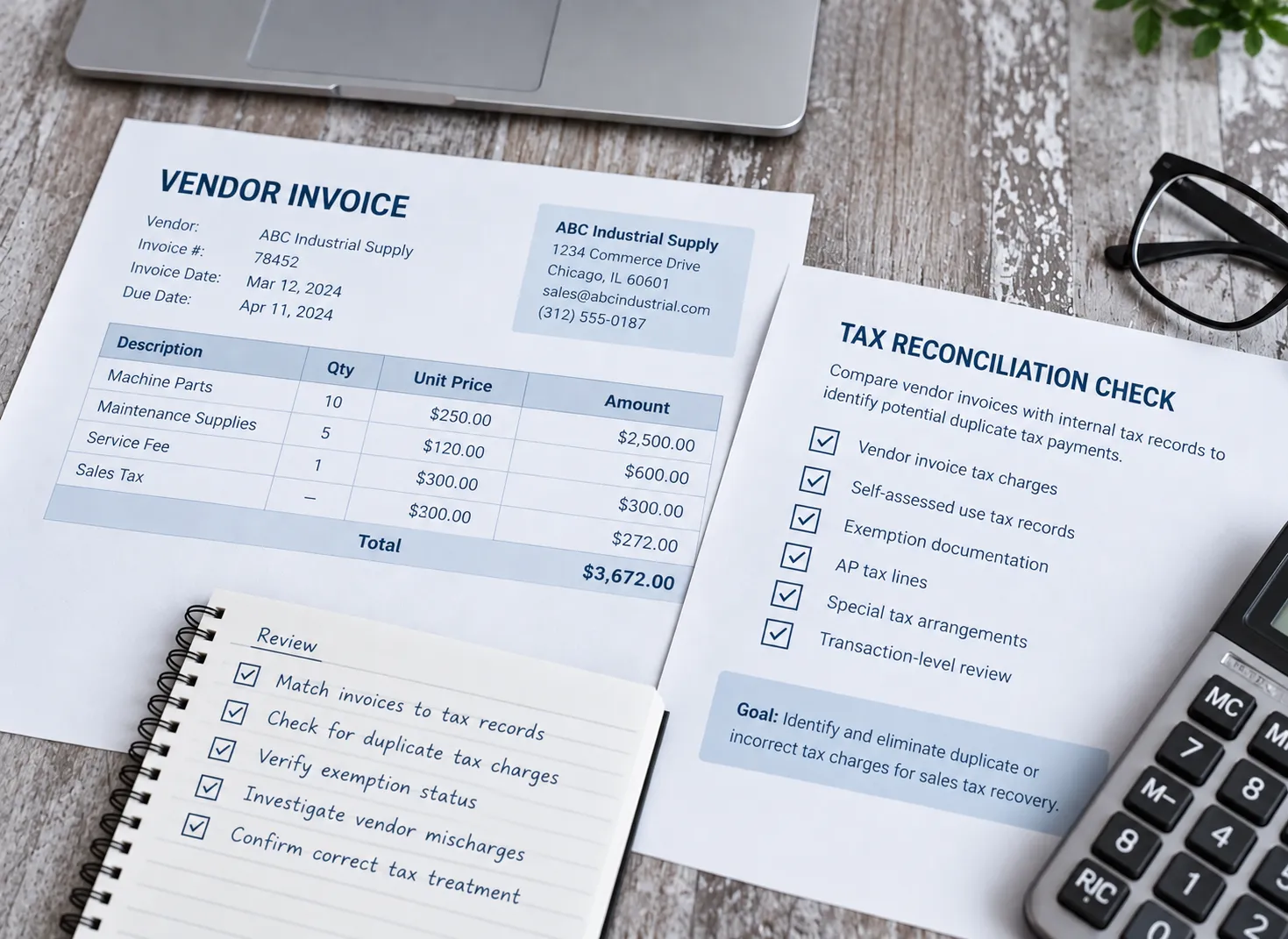
Businesses can sometimes pay tax through a vendor invoice even though the purchaser has already self-assessed the applicable use tax, creating a potential duplicate tax payment.
A Direct Pay transaction can also create a duplicate-payment issue if a vendor incorrectly charges tax even though the purchaser is responsible for self-assessing the applicable use tax.
The opportunity can appear in vendor invoices, AP tax lines, self-assessed use tax records, exemption documentation, special tax arrangements, or transactions where vendor and purchaser systems apply different treatment.
Vendor mischarges are also a recognized source of Sales & Use Tax overpayment that cost recovery consultants can identify, particularly when vendors have outdated exemption information or continue applying tax despite valid documentation.
For sales tax recovery, the key issue is not simply whether a vendor charged tax. It is whether the transaction was treated correctly under the applicable rules.
Why it matters
- Identifies instances where vendor-charged tax may overlap with internally self-assessed or otherwise accounted-for tax.
- Compares vendor invoices with tax accruals, exemption records, and transaction-level accounting data.
- Exposes recurring vendor mischarges across high-volume purchasing activity.
- Verifies whether tax was actually due under the applicable state and transaction rules.
- Eliminates process gaps that allow duplicate or incorrect tax treatment to recur.
Pro Tip: Look for experienced cost recovery consultants to reconcile tax at the transaction level, not only at the monthly GL level. A GL account can show how much tax was recorded, but it generally cannot establish whether a particular transaction was taxed twice. That transaction-level visibility is central to effective sales tax recovery.
Can I recover sales tax paid twice on the same transaction?
Potentially. When sales tax is charged by a vendor and use tax is also self-assessed on the same transaction, the duplicate payment may be recoverable. The process depends on state rules, transaction records, and whether the vendor or tax authority handles the correction.
5. Unmonitored Software and SaaS Taxability
What it is
Software, SaaS, digital products, maintenance, support, and related services can receive different Sales & Use Tax treatment depending on the state and the nature of the product or service.
There is no universal rule that all SaaS is taxable or that all SaaS is exempt. The treatment can depend on the jurisdiction, product structure, service components, use, purchasing entity, and how the transaction is classified.
This makes recurring software spending an increasingly relevant sales tax recovery opportunity.
Finance teams should examine cloud-based software, software licenses, recurring subscriptions, maintenance and support components, bundled software and services, digital products, and software purchased by different legal entities.
They should also look at software used for resale or in potentially exempt operations, as well as subscriptions added without corresponding changes to tax treatment.
Why it matters
- Reveals recurring tax overpayments across monthly and annual software subscriptions.
- Assesses how tax treatment applies to different products, service components, purchasing entities, and states.
- Distinguishes between software, support, maintenance, digital products, and bundled services where their treatment differs.
- Calculates the cumulative impact when an incorrect tax treatment repeats across billing cycles.
- Recovers eligible historical overpayments while correcting the treatment of future subscriptions.
Pro Tip: Do not assume that two software subscriptions receive identical tax treatment simply because both are classified as “software.” Review what is actually being purchased, how it is structured, where it is used, and which entity purchased it to determine whether sales tax recovery is warranted.
How long does it take to get a sales tax refund?
Sales tax refund timelines vary based on the state, claim complexity, supporting documentation, and whether the claim is handled by a vendor or tax authority. Straightforward claims may be resolved relatively quickly, while claims requiring additional review can take several months.
Maximize Savings Through Sales Tax Recovery
Overlooked exemptions, recurring utility charges, system errors, and inconsistent tax treatment can quietly increase a company’s tax burden. Reviewing these areas systematically gives finance teams a clearer path to validate historical overpayments and pursue sales tax recovery where eligible.
- Capture missed exemptions on machinery, equipment, repair parts, and qualifying R&D purchases.
- Recover recurring overpayments hidden within electricity, gas, and water charges.
- Correct ERP configurations before tax errors multiply across high-volume transactions.
- Reconcile invoices, accruals, and Direct Pay transactions to prevent duplicate tax payments.
- Engage cost recovery consultants to assess state-specific tax treatment on recurring software and SaaS purchases.
Turn Overpaid Tax Into Recovered Cash
Overpaid Sales & Use Tax can remain hidden in historical transactions even when current tax processes appear accurate. A targeted sales tax recovery review with cost recovery consultants gives finance teams an opportunity to identify eligible overpayments, validate them against applicable state rules, and pursue refunds that might otherwise remain on the books.
The SALT Group’s Transactional Tax Refund Reviews recover an average of $38,453 per engagement. It brings specialized transactional tax expertise and multi-state knowledge to this sales tax recovery process, with cost recovery consultants who track changing exemptions, incentives, rebates, and credits.
For multi-state businesses, where exemptions, taxability and refund procedures can vary by jurisdiction, SALT’s multi-state expertise and established relationships with state tax authorities help address state-specific questions and support more efficient refund filings, while its turnkey model minimizes the time required from internal finance teams. Because the engagement is performance-based, clients pay only when recoveries or savings are identified.
For finance leaders, cost recovery consultants can turn historical transaction data into a measurable sales tax recovery opportunity while strengthening tax treatment going forward.
Turn Tax Savings Into Better Margins
FAQs
1. How far back can I claim a sales tax refund?
Lookback periods vary by state, claim type, and the circumstances of the refund. Many states allow claims for roughly three to four years, but specific deadlines can differ. Businesses should review the applicable state rules and claim deadlines before determining how far back they can pursue a refund.
2. Will my sales tax refund claim trigger an audit?
A refund claim does not automatically mean a business will face an audit. However, tax authorities may request support for the claim. Clear transaction records, proof of payment, exemption documentation, and a defensible basis for sales tax recovery can help address questions efficiently.
3. What happens if my sales tax refund claim is denied?
A denied refund claim does not necessarily mean the underlying overpayment was ineligible for sales tax recovery. The business may be able to provide additional substantiation, correct deficiencies, or pursue available administrative appeal rights, depending on the state’s procedures and applicable deadlines.
4. Can I recover sales tax if my business is no longer operating in a state?
Potentially. Closing operations or deregistering does not automatically eliminate every refund opportunity, but eligibility and filing requirements vary by state. Businesses should confirm whether the relevant state permits former taxpayers to pursue refunds and whether any post-closure deadlines apply.
Capture More Value Through Sales Tax Recovery
A strong Sales & Use Tax recovery strategy goes beyond finding isolated overpayments. Finance teams can use historical reviews to uncover missed savings, correct recurring issues, and strengthen tax treatment going forward.
- Review exemptions: Revisit machinery, equipment, and qualifying R&D purchases for missed opportunities.
- Examine utilities: Check production-related electricity, gas, and water charges for incorrect tax treatment.
- Audit systems: Validate ERP tax configurations to prevent errors from spreading across transactions.
- Check vendors: Reconcile vendor charges and internal tax records to catch duplicate or incorrect payments.
- Assess software: Review recurring software and SaaS expenses as taxability rules change across states.
The SALT Group can help finance teams identify these opportunities, validate potential recoveries, and pursue eligible refunds with minimal internal effort.