

Uncover hidden overpayments, recover lost savings, and reduce ongoing operating costs across the spend categories that impact manufacturing profitability.
Executive Summary
How can manufacturers identify hidden operating cost overpayments and recover lost savings?
Manufacturers can identify hidden overpayments by reviewing Sales & Use Tax, freight, waste, facilities, and merchant service expenses against contracts, rates, and market benchmarks. Cost recovery addresses past overpayments, while cost reduction and optimization help lower unnecessary ongoing expenses.
For example, a vendor may increase rates without improving service levels, creating an opportunity to recover past overpayments and reduce future spend.
You could be paying more for everyday operating expenses than you realize, and your financial statements may not show where.
Manufacturers often focus on materials, labor, and freight costs, but profitability can also erode through tax overpayments, incorrect freight charges, unnecessary waste services, outdated vendor pricing, and contract escalators- the same hidden costs that cost optimization for manufacturers efforts are designed to catch.
The SALT Group has applied this approach across 5,000+ manufacturing clients over 38 years.
This guide shows you how to identify potential overpayments, determine which variances warrant action, pursue eligible recoveries, and strengthen manufacturing cost reduction across key manufacturing spend categories.
Define cost recovery vs. cost reduction vs. cost optimization
Cost recovery reclaims money already overpaid, through refunds, credits, or corrected billing. Cost reduction lowers what a manufacturer pays going forward, through renegotiated rates and eliminated fees. Cost optimization goes a step further, right-sizing services and contracts so spend matches actual need on an ongoing basis. Used together, they turn a one-time recovery into sustained savings.
Why Hidden Operating Cost Overpayments Matter
Manufacturers are under growing pressure to protect margins as input costs continue to rise. In the National Association of Manufacturers’ Q2 2026 Manufacturers’ Outlook Survey, 83.1% of manufacturers identified rising raw material costs as their top business challenge, up from 57.5% in Q1. Manufacturers also expect raw material and other input costs to increase 5.8% over the next 12 months, compared with 4.1% in the previous quarter.
These pressures make it more important to examine recurring operating expenses that may not appear significant on any single invoice, making manufacturing cost reduction an increasingly important part of protecting margins.
Reviewing those costs systematically can reveal billing errors, outdated pricing, unnecessary services, and other sources of avoidable spend.

Hidden Overpayments Quietly Reduce Manufacturing Profitability
Even small overpayments can become significant when they recur across thousands of transactions. A focused review can determine whether those discrepancies are legitimate, recoverable, or symptoms of an ongoing pricing, contract, service, or billing issue that may require a broader cost optimization strategy.
Common sources of hidden overpayments include:
- Recurring invoice errors that accumulate across high-volume transactions.
- Unclaimed tax exemptions, credits, refunds, or incorrectly applied taxes.
- Automatic vendor price increases that continue without meaningful review.
- Contract terms that no longer reflect current pricing or business requirements.
- Unnecessary services, fees, or charges that provide little additional business value.
- Inflated freight charges, unnecessary waste services, and outdated vendor pricing that go unchallenged year after year.
For manufacturers operating on tight margins, recovering these expenses can provide savings without requiring major changes to production, staffing, or infrastructure.
Why Internal Teams Miss Recoverable Savings
Finance and procurement teams already manage complex responsibilities, including budgeting, reporting, supplier relationships, purchasing, and payment processing. Reviewing every invoice, contract, tax charge, and vendor agreement in detail can be difficult without dedicated resources or specialized expertise.
As a result, potential cost recovery opportunities can remain embedded within routine operating expenses.
- Teams prioritize accurate payment processing over detailed historical cost audits.
- Complex tax rules can make missed exemptions, credits, and overpayments difficult to identify.
- Vendor pricing may not be regularly compared against current market benchmarks.
- Small discrepancies can seem insignificant when reviewed individually.
- Limited internal resources can make comprehensive spend reviews difficult to maintain.
External benchmarking and targeted expense reviews can complement internal Finance and Procurement teams by providing specialized category analysis that supports manufacturing cost reduction without shifting the review burden onto their day-to-day responsibilities.
Why a Proactive Operating Cost Review Matters
Waiting until rising expenses materially affect profitability can allow unnecessary costs to continue for months or years. A proactive review supports cost optimization for manufacturers by examining historical spending for recoverable overpayments while identifying opportunities to lower future expenses.
A structured review can help manufacturers:
- Analyze historical spending for recurring overpayment patterns.
- Benchmark vendor pricing against current market and regional rates.
- Review contracts before automatic renewals, escalators, or pricing changes take effect.
- Identify unnecessary services, fees, and charges.
- Recover eligible past overpayments while strengthening future cost controls.
The need for this approach is particularly relevant as manufacturers continue to face broad cost pressures. NAM’s Q2 2026 survey found that 71.8% of manufacturers cited trade uncertainty as a top business challenge, while 72.0% reported facing rising energy input costs related to the conflict in the Middle East.
Areas Where Manufacturers May Overpay
Manufacturers can uncover cost recovery and ongoing savings opportunities across the operating expense categories that most directly affect manufacturing cost reduction.
Because pricing, tax requirements, service levels, and contract terms can change over time, systematic reviews can identify historical overpayments while uncovering opportunities for ongoing expense reduction.
- Sales & Use Tax: Missed exemptions, credits, refunds, and incorrectly applied tax charges.
- Freight & Parcel: Rating errors, accessorial charges, surcharges, contract discrepancies, and unnecessary fees.
- Waste Management: Excessive pickups, oversized equipment, unnecessary services, rate increases, and incorrect service levels.
- Merchant Services: Processing fees, pricing discrepancies, and unfavorable transaction-related charges.
- Uniform & Facilities: Unused or excessive services, pricing discrepancies, and automatic contract escalators.
These categories can contain discrepancies and savings opportunities that routine accounts-payable processes may not identify because AP validates transactions against existing information rather than independently testing whether the underlying pricing, service, or tax treatment remains appropriate.
From Cost Leakage to Lasting Savings
Recovering past overpayments is only part of the opportunity. The strongest manufacturing cost reduction strategies combine historical recovery with changes that help prevent unnecessary expenses from recurring.
The next step is a structured process that moves from spend visibility and benchmarking to validated recovery, ongoing cost reduction, and controls that help prevent future leakage.
The Hidden Cash Sitting Inside Vendor Spend
Hidden savings often exist within everyday vendor transactions. Duplicate payments, invoice errors, unnecessary services, pricing inconsistencies, and overlooked contract terms can accumulate into significant financial losses. Identifying and recovering these costs helps improve cash flow without disrupting business operations.
The SALT Manufacturing Cost Recovery Framework: 5 Steps to Manufacturing Cost Reduction
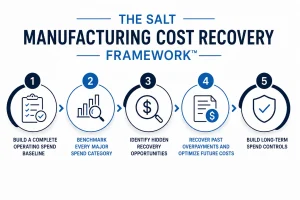
The SALT Manufacturing Cost Recovery Framework is the process The SALT Group’s consultants run on every engagement to uncover hidden overpayments and drive ongoing manufacturing cost reduction. It is not a checklist manufacturers run themselves.

Dedicated category consultants collect invoices, benchmark pricing, and negotiate with vendors and state tax authorities on the client’s behalf. The principle behind it is simple: what a manufacturer pays, what it should pay, and what it actually receives are three different numbers, and the gap between them is where cost recovery lives.
The five steps at a glance:
- Step 1. Build a Complete Operating Spend Baseline
- Step 2. Benchmark Every Major Spend Category
- Step 3. Identify Hidden Recovery Opportunities
- Step 4. Recover Past Overpayments and Optimize Future Costs
- Step 5. Build Long-Term Spend Controls
Step 1. Build a Complete Operating Spend Baseline

What it is
Establish a complete view of historical and current operating spend so potential overpayments, pricing changes, duplicate charges, and unnecessary services can be identified and investigated as part of a broader manufacturing cost reduction strategy. This creates the data foundation needed to identify duplicate charges, pricing discrepancies, tax overpayments, and unnecessary services.
How to implement
- Consolidate AP History: Compile multiple years of Accounts Payable records to identify recurring charges, historical payments, unusual increases, and potential overpayment patterns across operating expense categories.
- Connect ERP Data: Pull relevant ERP purchasing and payment data to connect vendors, invoices, purchase orders, payment history, and spend categories for more complete analysis.
- Collect Vendor Records: Review vendor master files, contracts, purchase orders, and service agreements to understand pricing structures, negotiated terms, renewal dates, and applicable service requirements.
- Organize Category Documents: Gather tax documentation, freight and parcel invoices, waste invoices, merchant statements, uniform records, and facility contracts for category-level review.
Pro Tip:Start with at least 24 to 36 months of historical data. Longer payment histories make recurring errors, pricing increases, and small invoice-level overpayments easier to identify.
Step 2. Benchmark Every Major Spend Category

What it is
Compare actual operating costs against the benchmarks appropriate to each category, including market, industry, regional, tax, contract, and service benchmarks.
The goal is to determine whether current costs are reasonable for the company’s volume, location, service requirements, and contractual terms, creating a stronger basis for cost reduction strategies.
How to implement
- Establish Relevant Benchmarks: Compare vendor pricing against appropriate current market rates, accounting for volume, location, service scope, and other factors that affect comparability.
- Compare Industry Costs: Use relevant industry benchmarks to identify unusual spending patterns and determine whether differences warrant further investigation.
- Analyze Regional Pricing: Evaluate regional rates for waste management, facilities, freight, and other location-dependent operating expenses.
- Validate Contract Terms: Compare invoices against negotiated rates, contractual terms, escalators, service levels, and renewal provisions to identify billing discrepancies or unfavorable conditions.
- Measure Service Utilization: Compare contracted services with actual usage to identify overservicing, unnecessary capacity, or opportunities to right-size existing arrangements.
- Benchmark Carrier Rates: Evaluate freight and parcel pricing, surcharges, and carrier terms against competitive rates and current shipping requirements.
Pro Tip:Benchmarking creates negotiating leverage. Instead of asking vendors for lower prices without evidence, manufacturers can negotiate from documented market and utilization data.
Step 3. Identify Hidden Recovery Opportunities

What it is
Examine each major operating expense category for past overpayments, billing errors, unfavorable pricing, unused services, and service discrepancies that may create cost reduction opportunities.
Each finding should then be validated to determine whether it represents a recoverable overpayment, an ongoing savings opportunity, or a legitimate cost difference.
Sales & Use Tax
- Review Tax Payments: Analyze historical transactions for incorrectly charged taxes, missed exemptions, unused credits, and potential refunds that support expense reduction.
- Validate Tax Treatment: Compare vendor tax charges with current state requirements and applicable exemptions, credits, and tax documentation.
Example: A manufacturer operating across multiple states may continue paying sales tax on qualifying purchases because exemptions were not applied consistently. A historical review can uncover refund opportunities while supporting ongoing manufacturing cost reduction through corrected tax treatment.
Freight & Parcel
- Audit Shipping Charges: Review freight and parcel invoices for incorrect surcharges, rating errors, duplicate charges, and discrepancies against negotiated carrier contracts.
- Check Contract Compliance: Compare carrier billing against contracted rates, discounts, accessorial charges, and agreed pricing structures to identify cost recovery opportunities.
Example: A manufacturer may negotiate discounted carrier rates but still receive invoices with incorrect accessorial charges or outdated pricing. Comparing shipment-level billing against contracted rates can uncover recurring discrepancies and create manufacturing cost reduction opportunities across high-volume shipments.
Waste Management
- Review Service Levels: Compare dumpster sizes, pickup frequency, and contracted services with actual waste volumes to identify overservicing and unnecessary capacity.
- Challenge Rate Increases: Examine automatic increases, fuel surcharges, environmental fees, and miscellaneous charges for unsupported or excessive costs.
Example: A facility may be paying for larger containers or more frequent pickups than its actual waste volume requires. Comparing contracted services with actual usage can identify opportunities for expense reduction by right-sizing services and eliminating unnecessary spend.
Merchant Services
- Analyze Processing Fees: Review merchant statements for hidden fees, interchange-related charges, pricing discrepancies, and unnecessary processing costs.
- Optimize Interchange Costs: Review Effective Processing Costs: Analyze total processing costs, including interchange-related charges, fees, transaction mix, and pricing terms, to identify opportunities to reduce unnecessary card-processing expense.
Uniform & Facilities
- Review Service Frequency: Compare contracted service schedules with actual operational requirements to identify unnecessary or excessive services.
- Audit Contract Escalators: Examine automatic increases and renewal provisions against market pricing and current service requirements.
Pro Tip: Don’t dismiss small discrepancies. A minor recurring overcharge multiplied across thousands of transactions can create a substantial cost recovery opportunity and support ongoing manufacturing cost reduction
Step 4. Recover Past Overpayments and Optimize Future Costs

What it is
Convert validated opportunities into financial results through vendor negotiations, refund claims, credits, contract changes, service adjustments, and implementation that reduce past and future unnecessary costs and support measurable manufacturing cost reduction.
How to implement
- Negotiate Vendor Rates: Use documented benchmarks and discrepancies to negotiate lower rates, remove unnecessary charges, and improve commercial terms.
- File Refund Claims: Pursue applicable tax refunds and recovery claims supported by historical transaction records and documentation.
- Request Vendor Credits: Submit documented billing discrepancies and pursue credits or adjustments for confirmed overpayments.
- Renegotiate Contracts: Address unfavorable pricing, automatic escalators, service terms, and renewal provisions to strengthen expense reduction.
- Right-Size Services: Adjust service frequency, equipment, capacity, or scope to reflect actual operational requirements and eliminate unnecessary spend.
- Implement Changes: Coordinate approved pricing, contract, service, and billing changes to ensure identified savings become measurable ongoing reductions.
Example: If a vendor repeatedly bills above the contracted rate, recovering the past overpayment is only the first step. Correcting the billing setup, contract terms, or invoice controls addresses the underlying cause and helps prevent the same leakage from recurring.
Pro Tip: Recovery should not stop at receiving a refund. Correct the pricing, contract, or service issue that caused the overpayment so the same cost doesn’t return.
Step 5. Build Long-Term Spend Controls

What it is
Establish ongoing controls that protect recovered savings, support sustained manufacturing cost reduction, and identify new leakage as vendors, contracts, regulations, and operating requirements change.
How to implement
- Schedule Annual Benchmarking: Reassess major vendor pricing annually to identify market changes, emerging savings opportunities, and weakening contract economics.
- Conduct Quarterly Reviews: Review operating spend at an appropriate frequency based on category complexity, transaction volume, contract terms, and the likelihood of pricing changes or leakage.
- Strengthen Procurement Governance: Establish clear purchasing controls, approval processes, vendor ownership, and accountability for major operating expense categories.
- Manage Contract Renewals: Track renewal dates, pricing escalators, service requirements, and renegotiation windows before contracts automatically extend.
- Use Vendor Scorecards: Measure vendors against pricing, service levels, billing accuracy, contract compliance, and operational performance.
- Validate Invoices: Implement recurring invoice checks to identify duplicate charges, incorrect rates, unexpected fees, and discrepancies before payment.
- Track Exceptions: Create exception reporting for unusual charges, price increases, service changes, and recurring billing anomalies requiring investigation.
- Educate Finance Teams: Train accounting, finance, procurement, and operations teams to recognize common overpayment patterns and cost recovery opportunities.
- Monitor Continuously: Maintain ongoing visibility into operating expenses so new cost leakage can be identified before it compounds.
Pro Tip: Assign ownership for every major spend category. Without accountability, even well-documented savings opportunities can disappear when contracts, vendors, or internal responsibilities change.
The SALT Manufacturing Cost Recovery Framework turns fragmented operating spend data into a repeatable process for identifying and validating opportunities, recovering eligible overpayments, driving manufacturing cost reduction, and controlling future leakage.
With the framework established, the next section examines practical examples of good and bad approaches to operating cost recovery.
Real-World Manufacturing Cost Reduction Examples: What Works and What Doesn’t
Expense reduction depends on how consistently companies review what they spend, what they should be paying, and where costs may be leaking. These two illustrative scenarios show the difference between a reactive approach and a structured cost recovery strategy.
Bad Example: Letting Freight Costs Become Permanent
Company background: A mid-sized metal manufacturer operates multiple facilities and ships products throughout the region.
The challenge: Freight is a significant operating expense, but the finance team primarily checks invoices for basic accuracy and relies on carrier agreements negotiated several years ago.
- What went wrong: Freight rates and accessorial charges increased without regular benchmarking.
- Hidden issue: Fuel surcharges, additional fees, and missed contractual discounts were not being consistently reviewed.
- Why it continued: No one was responsible for comparing carrier invoices against current market rates and negotiated terms.
- Impact: Recurring overcharges continued to increase operating costs and reduce potential savings.
Why this approach fails: A negotiated carrier agreement does not guarantee that the company is still receiving the best available pricing. Without ongoing benchmarking and invoice reviews, small discrepancies can become recurring costs.
Good Example: Turning Multiple Cost Leaks Into Savings
Company background: A regional food manufacturer operates multiple processing facilities with significant spending across freight, waste management, and Sales & Use Tax.
The challenge: Finance notices operating costs increasing but does not have the time or specialized expertise to review every category in depth.
- What the review finds: Potential freight billing discrepancies, waste services that exceed actual requirements, and possible tax overpayments.
- What is analyzed: Historical invoices, contracts, service utilization, vendor pricing, and applicable tax requirements.
- What is addressed: Billing discrepancies are challenged, waste services are right-sized, vendor terms are reviewed, and eligible tax recovery opportunities are pursued.
- Outcome: The manufacturer can recover eligible past overpayments while addressing the underlying issues that could cause future cost leakage.
Why this approach works: Instead of treating operating expenses as fixed, the manufacturer continuously validates pricing, contracts, service levels, and actual usage. This creates opportunities for both immediate cost recovery and ongoing manufacturing cost reduction.
The examples above are illustrative scenarios designed to demonstrate how hidden operating costs can affect manufacturers. They are not representations of specific client results.
The difference is clear: manufacturing cost reduction becomes more effective when manufacturers validate whether recurring costs remain appropriate, competitive, and aligned with actual operating requirements.
Best Practices for Recovering Hidden Operating Costs
Recovering hidden operating costs requires more than reviewing invoices. Manufacturers need disciplined procurement controls, category-specific benchmarking, and recurring validation to turn cost recovery into sustainable manufacturing cost reduction.

Use these practices to identify leakage earlier, validate savings opportunities, and protect recovered savings:
Pro Tip 1: Tie Contracts to Market Benchmarks
Rebenchmark vendor agreements before renewal and whenever escalators activate, checking rates against current market and supplier cost movements.
Pro Tip 2: Separate Service Scope From Vendor Pricing
Review usage separately from pricing, and compare price increases against actual volume and service needs to spot unexplained hikes.
Pro Tip 3: Build Category-Specific Invoice Audits
Set targeted audit rules for freight, waste, merchant, tax, and facility invoices, validated against contracted rates rather than general AP checks.
Pro Tip 4: Track Recoveries Beyond the Initial Refund
Document each recovery, find its root cause, and fix the contract or process behind it so the leakage does not return.
Pro Tip 5: Review Multi-Location Spend Collectively
Aggregate spend across facilities before negotiating to reveal inconsistent pricing and build stronger leverage.
Pro Tip 6: Prioritize High Leakage Categories First
Start where pricing is complex or transaction volume is high, since small errors compound fastest there.
Pro Tip 7: Use Independent Performance Based Reviews
Bring in specialized cost recovery reviewers when internal teams lack the category expertise or bandwidth to audit alone.
Strong manufacturing cost reduction programs should uncover immediate recovery opportunities while strengthening the controls that prevent future operating cost leakage.
The next section examines the common mistakes manufacturers make when managing operating expenses and why those mistakes allow overpayments to persist.
Common Mistakes That Lead to Hidden Overpayments
Hidden overpayments rarely come from one major error. In manufacturing finance and procurement, they usually build through weak invoice controls across multiple plants, vendor pricing that never gets rebenchmarked against production volume, missed multi-state tax exemptions, and recurring shipment-level discrepancies that quietly erode margins. Strong manufacturing cost reduction practices catch these leaks before they become permanent line items.
Avoid these common mistakes before they undermine profitability and limit manufacturing cost reduction opportunities:
The common thread is specific to manufacturing: plants, shipments, and vendor contracts multiply faster than finance and procurement teams can individually validate them. Strong controls turn one-time cost recovery into sustained savings and support ongoing manufacturing cost reduction.
Next, use the Vendor Cost Recovery Checklist to assess whether your organization is actively identifying, recovering, and preventing hidden operating overpayments.
The Manufacturing Cost Reduction Checklist for Hidden Overpayments
Manufacturers should periodically test recurring operating costs against current contracts, market conditions, actual service requirements, and transaction data rather than assuming established expenses remain appropriate. This checklist helps finance and procurement leaders identify cost recovery opportunities and strengthen ongoing expense reduction controls.
| Review Area | Checklist Question |
| Freight | Are freight invoices tested for surcharges, rating errors, duplicate charges, and contract compliance? |
| Parcel | Are parcel rates, accessorial fees, discounts, and carrier terms benchmarked regularly? |
| Waste Management | Do equipment sizes and pickup frequencies match actual waste volumes and operational needs? |
| Merchant Services | Are processing fees and interchange-related charges independently analyzed for optimization opportunities? |
| Facilities & Uniforms | Are service levels, pricing, escalators, and contract terms reviewed before renewal? |
| Vendor Pricing | Are major vendor rates benchmarked against current market and regional pricing? |
| Contract Escalators | Are automatic price increases identified and challenged before implementation? |
| Invoice Controls | Are duplicate invoices, incorrect rates, recurring fees, and billing exceptions systematically identified? |
| Procurement Governance | Are category owners accountable for vendor performance, pricing, renewals, and spend controls? |
| Independent Review | Has an independent, performance-based operating cost review been completed recently? |
How to assess your results: Multiple unchecked items indicate potential gaps in spend visibility, vendor management, or cost recovery. Prioritize categories with high transaction volume, complex pricing, or recurring fees first.
A consistent review process can help manufacturers recover past overpayments while creating stronger controls to reduce long-term expenses.
Recover Overpayments and Reduce Ongoing Operating Costs

Hidden operating cost overpayments rarely come from a single source. They build through missed tax opportunities, outdated contracts, invoice discrepancies, and unchallenged vendor pricing. The SALT Manufacturing Cost Recovery Framework exists to address this directly: it gives manufacturers a structured way to reclaim past overpayments while ongoing reviews support sustainable manufacturing cost reduction and stronger profitability.
The SALT Group runs this framework for manufacturers, uncovering hidden overpayments and optimizing ongoing operating expenses through performance-based cost reduction services. The manufacturer’s role stays simple: grant access to invoices and contracts, and approve what SALT finds. SALT’s consultants do the rest, auditing, benchmarking, negotiating with vendors, and filing tax claims, unlike hourly firms that bill regardless of results or generalist firms that spread thin across 40-plus spend categories.
Since 1988, The SALT Group has applied this approach across more than 5,000 manufacturing clients, delivering an average of $165,000 in benefits per engagement on a purely performance-based model.
Find out where hidden costs may be eroding your margins. The SALT Group can apply the Framework to your operating expenses to uncover recoverable overpayments and ongoing savings opportunities, with minimal internal effort required.
Talk to a Cost Recovery Expert
Frequently Asked Questions
1. What does it cost to have The SALT Group review our operating expenses?
Nothing upfront. The SALT Group works on a performance-based model: fees are tied to identified recoveries and savings, and if no benefits are found, there is no fee. This allows manufacturers to pursue manufacturing cost reduction without taking on the upfront cost of a traditional consulting engagement.
2. How much time will our finance and procurement team need to commit?
Very little. SALT’s consultants collect invoices and contracts directly, via secure upload or onsite, and handle the analysis, benchmarking, and vendor negotiations themselves. Internal teams typically provide access to records and approve findings rather than running the manufacturing cost reduction review themselves.
3. How is this different from having our CPA firm or an ERP audit handle it?
Most CPA firms focus on tax compliance, while ERP systems primarily show what was billed and paid. Manufacturing cost reduction requires a broader review of spend categories such as freight, waste, merchant services, facilities, and Sales & Use Tax, including benchmarking, contract validation, service utilization, and recovery analysis. SALT’s category-specific consultants are built to perform this specialized review.
4. Will negotiating with our vendors on our behalf damage those relationships?
SALT negotiates from documented benchmarks and invoice discrepancies rather than generic pressure for lower prices, which keeps the conversation factual rather than adversarial. Vendors are typically more receptive to evidence-based corrections than blanket demands.
5. How long does a typical engagement take, and when do we see results?
Timelines vary by category and by how many locations are involved, but the process starts with a records-based review, not a lengthy internal project. Tax refunds and vendor credits are pursued as they are identified, so recoveries do not wait for the full manufacturing cost reduction review to finish before any results appear.
6. Is expense reduction still worthwhile if our vendor contracts are well managed?
Yes. Well-managed contracts can still contain outdated pricing, automatic escalators, service terms, or billing discrepancies. An independent review can test whether current costs remain competitive and aligned with actual requirements, helping identify manufacturing cost reduction opportunities that routine contract management may miss.
7. Which areas should manufacturers prioritize for cost reduction first?
Start with spend categories that combine high transaction volume, complex pricing, frequent fees, regulatory requirements, or significant supplier dependence. Freight, Sales & Use Tax, waste, merchant services, and facilities can all warrant review. Prioritizing these areas can help manufacturers identify manufacturing cost reduction opportunities where small discrepancies may compound into high annual costs.
Research & References
- 2026 Second Quarter Manufacturers’ Outlook Survey — National Association of Manufacturers (NAM): https://nam.org/2026-second-quarter-manufacturers-outlook-survey/
- Rising Input Costs Top Manufacturers’ Concerns in Q2 Survey — NAM: https://nam.org/rising-input-costs-top-manufacturers-concerns-in-q2-survey/
- Manufacturers’ Q1 Survey: Trade Business Challenges Persist, but Optimism Up — NAM: https://nam.org/manufacturers-q1-survey-trade-business-challenges-persist-but-optimism-up/
- The End of “Set It and Forget It” Pricing? Opportunities for Market-Based Freight Contracts — MIT/Research: https://arxiv.org/abs/2202.02367
- A Market-Based Pricing Model for Transportation Contracts — Supply Chain Management Review: https://www.scmr.com/article/a_market_based_pricing_model_for_transportation_contracts