

Learn how manufacturers can use cost reduction strategies to uncover hidden overpayments, recover past costs, and optimize future spend.
Executive Summary
What are the most effective cost reduction strategies for manufacturers?
The most effective cost reduction strategies for manufacturers include spend analysis, benchmarking, overpayment recovery, vendor negotiations, and service-level optimization. These strategies can reduce unnecessary costs across areas such as Sales & Use Tax, waste, freight, parcel, facilities, and merchant services while supporting long-term savings.
How can manufacturers reduce operating costs without disrupting essential operations?
Manufacturers can reduce operating costs by identifying billing errors, unnecessary fees, outdated pricing, and excess service levels rather than cutting essential operations. Analyzing spend, benchmarking costs, renegotiating vendor terms, and verifying post-implementation billing can help reduce expenses while maintaining necessary service levels.
Manufacturers are facing continued pressure to protect margins. In 2025, 87% of surveyed manufacturers identified immediate cost-reduction opportunities as important to their cost-takeout efforts, compared with 93% in 2024.
For mid-sized manufacturers, meaningful savings may already exist within everyday operating spend. Finance teams often have limited time and specialized expertise to continuously review invoices, contracts, tax charges, vendor pricing, and service levels across multiple operating categories.
As a result, overpayments and recurring cost leakage can continue unnoticed even when overall operations remain stable. Effective cost reduction strategies address these hidden costs while helping maintain essential operations.
Why Recovering Hidden Overpayments Matters for Manufacturers
Hidden overpayments rarely come from one major billing mistake. They build gradually through outdated rates, unnecessary fees, tax errors, contract escalators, and services that no longer match actual business needs. For manufacturers, identifying these leaks is a key part of effective cost reduction strategies.
Identifying these leaks helps manufacturers:
- Recover past overpayments that would otherwise remain lost.
- Reduce recurring expenses by correcting unnecessary charges and misaligned services.
- Strengthen vendor negotiations with current market benchmarks and actual spend data.
- Prioritize high-value opportunities with the greatest financial impact.
- Prevent future cost leakage by addressing the causes of recurring overpayments.
A $1.50 overpayment per invoice may seem insignificant, but across 10,000 invoices annually for four years, it can total $60,000.
What role do cost reduction strategies play in recovering overpayments?
Cost reduction strategies help manufacturers go beyond identifying overpayments. They combine spend analysis, category expertise, benchmarking, and documentation to validate findings, recover eligible refunds or credits, correct billing issues, and reduce the risk of similar costs recurring.
The SALT Group Manufacturing Cost Recovery Framework
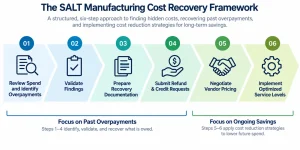
Manufacturers can lose margin through tax overpayments, inflated vendor rates, unnecessary fees, and services that no longer match actual needs. The SALT Group Manufacturing Cost Recovery Framework provides a structured approach to finding these leaks, recovering past overpayments, and applying effective cost reduction strategies.
The framework follows six connected steps:
Together, they support immediate recovery, ongoing expense reduction, and stronger control over future operating spend while helping manufacturers protect savings over time.
In short, the SALT Group Manufacturing Cost Recovery Framework moves from finding leakage to validating it, recovering what is owed, and locking in future savings. The first four steps focus on past overpayments; the final two apply cost reduction strategies to turn those findings into ongoing savings.
Step 1: Review Spend and Identify Overpayments
What it is:
The process begins by reviewing invoices, contracts, taxes, and operating spend to identify overpayments, unnecessary charges, pricing discrepancies, and opportunities to reduce costs across key manufacturing categories.
How to implement:
- Analyze Historical Invoices: Review recurring charges, rate increases, surcharges, tax discrepancies, and other potential overpayments to uncover savings opportunities.
- Review Vendor Contracts: Compare contracted rates, terms, service scopes, and escalators against actual invoices to identify unjustified or outdated charges that can be corrected.
- Map Spend Categories: Prioritize Sales & Use Tax, waste, freight, parcel, facilities, and merchant services where meaningful savings opportunities may exist.
Pro Tip: Start with high-volume, recurring spend. Small errors repeated across thousands of invoices can create significant recovery and savings opportunities.
Step 2: Validate Findings
What it is:
Validation confirms whether identified overpayments represent legitimate recovery opportunities or opportunities to reduce future costs by assessing applicable rules, contractual terms, actual usage, vendor pricing, and relevant market benchmarks.
How to implement:
- Apply Category Expertise: Evaluate findings using specialized knowledge of Sales & Use Tax rules, vendor pricing structures, fees, contracts, and service-specific cost drivers. For manufacturers operating across multiple states, this includes reviewing differences in applicable tax rules, exemptions, credits, and refund requirements to identify viable savings opportunities.
- Benchmark Current Costs: Compare existing rates and charges against relevant market benchmarks to determine whether the business is paying more than necessary and identify opportunities for future savings.
- Confirm Savings Opportunities: Separate legitimate recoveries from normal costs and prioritize opportunities with clear financial impact and supporting evidence.
Pro Tip: Benchmark the total delivered cost, not just the headline rate. Surcharges, fees, escalators, and add-ons can materially change the actual cost.

Step 3: Prepare Recovery Documentation
What it is:
This step organizes the evidence needed to substantiate identified overpayments and support refund submissions, vendor credits, billing corrections, or future cost savings.
How to implement:
- Compile Supporting Records: Gather invoices, transaction details, contracts, tax information, and other documentation needed to substantiate each recovery opportunity.
- Document Findings Clearly: Record the original charge, identified issue, applicable correction, and expected recovery or savings to create a clear audit trail.
- Prepare Recovery Materials: Organize supporting information required for refund submissions and vendor corrections to reduce delays during the recovery process.
- Pro Tip: Document the original charge, correct charge, difference, and supporting evidence for every finding to make recovery easier to verify and strengthen the case.
Pro Tip: Document the original charge, correct charge, difference, and supporting evidence for every finding to make recovery easier to verify and strengthen the case.
Step 4: Submit Refund & Credit Requests
What it is:
Validated findings move into the recovery process, where eligible tax overpayments and confirmed vendor charges are formally submitted for refunds, credits, or billing corrections that recover past costs and support future savings.
How to implement:
- Submit Tax Recoveries: Submit properly supported refund requests for eligible Sales & Use Tax overpayments through applicable state processes.
- Request Vendor Credits: Present validated billing issues to vendors and request appropriate credits or corrections for confirmed overcharges.
- Track Submitted Recoveries: Maintain records of submitted requests, outstanding questions, and resolutions until identified recoveries are completed and savings are realized.
Pro Tip: Prioritize recoveries by financial value and applicable filing requirements so high-value or time-sensitive opportunities are not overlooked.
Step 5: Negotiate Vendor Pricing
What it is:
Validated spend findings provide the evidence needed to challenge vendor pricing, unnecessary fees, contract terms, and service costs. These cost reduction strategies can help manufacturers lower future spend while maintaining the service levels required for efficient operations.
How to implement:
- Use Market Benchmarks: Bring current market pricing and category-specific benchmarks into vendor discussions to establish a defensible basis for negotiation.
- Challenge Excess Charges: Address unnecessary fees, escalators, unfavorable terms, and pricing that no longer reflects the company’s actual scope or usage.
- Renegotiate Service Terms: Align pricing and contractual terms with actual requirements while maintaining the service levels necessary for efficient operations.
- Pro Tip: Negotiate from actual spend and market evidence, not a target percentage reduction. Specific evidence gives vendors clear issues to address.
Pro Tip: Negotiate from actual spend and market evidence, not a target percentage reduction. Specific evidence gives vendors clear issues to address.
Step 6: Implement Optimized Service Levels
What it is:
Negotiated savings become operational by implementing revised pricing, service scopes, frequencies, and contract terms that support cost reduction strategies and ongoing savings.
How to implement:
- Right-Size Services: Adjust service frequency, quantities, or scopes to reflect actual operational requirements rather than maintaining outdated service levels.
- Implement New Pricing: Ensure negotiated rates, fees, and terms are accurately reflected in vendor agreements and subsequent invoices to secure negotiated savings.
- Verify Invoice Changes: Review future invoices to confirm that negotiated pricing and service adjustments have been correctly applied.
Pro Tip: Confirm every negotiated change appears in both the vendor contract and billing system so agreed savings reach future invoices.
How SALT Executes the Framework
The SALT Group Manufacturing Cost Recovery Framework connects past overpayment recovery with cost reduction strategies, helping manufacturers turn overlooked cost leakage into measurable financial results with minimal internal effort and a performance-based model.
- One Point of Contact: A dedicated Client Manager serves as the project manager and primary point of contact throughout the review.
- Coordinated Consulting Teams: Specialists across spend categories work together so multiple savings opportunities can be addressed through one streamlined engagement.
- Minimal Client Effort: Consultants manage the detailed analysis, negotiations, recovery activities, and coordination, allowing Accounting and Finance teams to remain focused on core operations.

Real-World Examples of Recovering Hidden Overpayments
A structured review across multiple operating spend categories can uncover significant savings that routine invoice processing may miss. These examples show how cost reduction strategies can identify both one-time recoveries and recurring expense reduction opportunities.
Incomplete Approach: Relying on a Limited Internal Cost Review
A mid-sized manufacturer with one production facility reviews its operating spend after noticing that costs have steadily increased despite relatively stable operations. The finance team reviews waste, freight, parcel, facilities, and merchant services and identifies several opportunities:
- Outdated pricing: Vendor rates no longer reflect current market conditions.
- Excess service levels: Certain services exceed the company’s actual operational needs.
- Recurring fees: Additional charges have continued without regular review.
- Vendor terms: Existing agreements provide limited leverage for controlling future costs.
The team negotiates improved terms, corrects some billing issues, and adjusts selected service levels.
However, without specialized expertise and market benchmarks, it cannot determine whether all overpayments and potential savings opportunities have been identified.
Outcome: The company achieves some savings but leaves additional recovery and ongoing expense reduction opportunities undiscovered.
Real-World Example: How Microflex Uncovered $752K in Savings
Microflex, a manufacturing company with approximately 90 employees and $27 million in annual sales, engaged the SALT Group to review several operating spend categories.
Engagement profile:
- Industry: Manufacturing
- Employees: 90
- Annual sales: $27 million
- Locations: 1
- Engagement length: Approximately 2 years
- Categories reviewed: Waste, Uniform/Facility, Merchant Card, Parcel, Freight
The review identified $752,346.60 in savings, including recurring annual savings. The breadth of the review allowed multiple spend categories to be examined rather than limiting the opportunity to a single expense area. The result was a substantial overall savings opportunity across the company’s operating spend.
Key takeaway: Reviewing multiple operating spend categories together can reveal more recovery and expense reduction opportunities than addressing individual vendors or expense lines separately.
Best Cost Reduction Strategies for Manufacturers
Recovering hidden overpayments is most effective when manufacturers turn identified findings into measurable action. The following practices can help strengthen negotiations, protect recovered value, and maintain savings over time.
Use these Pro Tips to strengthen savings and control ongoing spend:
Pro Tip: Benchmark Total Cost
Compare base rates alongside surcharges, fees, escalators, and ancillary charges to understand the vendor’s true cost. For freight, parcel, waste, and facilities services, also compare contracted service levels with actual usage to identify pricing and scope gaps.
Pro Tip: Right-Size Service Levels
Compare contracted services with actual usage to identify excess capacity, unnecessary frequency, or services that no longer match actual operating needs.
Pro Tip: Validate Before Negotiating
Establish the source and financial impact of each overpayment before approaching vendors, creating stronger leverage for cost reduction strategies.
Pro Tip: Separate Recoveries From Savings
Track historical overpayment recoveries separately from recurring expense reduction to measure recovered cash and recurring savings accurately.
Pro Tip: Document Every Finding
Maintain transaction-level evidence for each recovery opportunity, particularly tax findings that require substantiation during refund submissions and support cost reduction strategies.
Pro Tip: Challenge Automatic Escalators
Review contractual price increases against current market conditions and actual service requirements rather than accepting scheduled increases without scrutiny.
Pro Tip: Verify Post-Implementation Billing
Review invoices after changes take effect to confirm negotiated rates, credits, and service adjustments are accurately reflected and deliver the expected savings.
These cost reduction strategies help manufacturers move beyond one-time recovery toward sustained control of operating spend and stronger profit margins.
Next, we’ll examine how manufacturers can sustain recovered savings and prevent future cost leakage.
Common Mistakes in Cost Reduction Strategies
Manufacturers can undermine savings opportunities by focusing only on obvious billing errors or treating recovery as a one-time exercise. Avoiding these mistakes helps protect recovered cash and future expense reduction.
The most common mistakes include:
| Common Mistakes | What You Should Do |
| Reviewing only invoice errors | Examine contracts, service levels, tax treatment, surcharges, and market pricing, not just incorrect invoice amounts. |
| Accepting vendor rates as benchmarks | Compare total costs against relevant market benchmarks to identify pricing gaps and strengthen negotiation leverage. |
| Ignoring small recurring charges | Analyze recurring invoice-level charges; small overpayments can compound into significant recoveries across thousands of transactions. |
| Negotiating without spend data | Build negotiations around actual volumes, historical spend, service requirements, and benchmarked pricing to create measurable savings leverage. |
| Overlooking service-level changes | Reassess pickup frequency, quantities, and contracted scope against current usage before renewing or renegotiating services to support ongoing expense reduction. |
| Stopping after the recovery | Verify future invoices and vendor billing to ensure negotiated rates, credits, and service changes are actually implemented. |
| Relying entirely on internal reviews | Use specialized expertise for complex tax rules, category benchmarks, and recovery opportunities that internal teams may lack the time or resources to pursue. |
Avoiding these mistakes allows manufacturers to apply cost reduction strategies as an ongoing margin-improvement process rather than a one-time search for billing errors.
Next, we’ll look at the measurable benefits manufacturers can achieve by systematically recovering and optimizing hidden operating costs.
Manufacturing Cost Recovery Checklist: Identify and Reduce Hidden Costs
Use this checklist to determine whether your manufacturing business is actively identifying overpayments, recovering eligible costs, and protecting future savings through cost reduction strategies across major operating spend categories.
| Check | What to Verify |
| ☐ | Review historical invoices for recurring overcharges, fees, surcharges, and rate increases. |
| ☐ | Compare vendor pricing against current market benchmarks and actual service requirements. |
| ☐ | Review Sales & Use Tax for misapplied taxes, missed exemptions, credits, and recoverable overpayments. |
| ☐ | Assess service levels to confirm waste, freight, parcel, facilities, and other services match actual usage. |
| ☐ | Examine contract terms for automatic escalators, unfavorable pricing, and outdated service scopes. |
| ☐ | Validate recovery opportunities with supporting transaction and contract documentation. |
| ☐ | Submit eligible recoveries through appropriate refund submissions or vendor credit processes. |
| ☐ | Renegotiate ongoing costs using spend data, category expertise, and market benchmarks to support expense reduction. |
| ☐ | Verify implemented savings by checking post-negotiation invoices against agreed rates and terms. |
| ☐ | Track recurring savings separately from one-time recoveries to measure sustained margin impact. |
A completed checklist gives finance teams a practical starting point for applying cost reduction strategies to past overpayments and ongoing spend leakage.

Turn Hidden Overpayments Into Lasting Savings
For manufacturers, reducing costs is not simply about cutting budgets. Effective cost reduction strategies uncover hidden operating overpayments, recover past losses, and reduce ongoing expenses across critical spend categories.
When supported by accurate spend analysis and benchmarking, these strategies can also help manufacturers strengthen margins without disrupting essential operations.
The SALT Group Manufacturing Cost Recovery Framework provides a structured approach to reviewing spend, validating findings, recovering eligible refunds and credits, negotiating vendor pricing, and implementing optimized service levels. This helps manufacturers turn overlooked cost leakage into measurable savings and stronger margins.
With more than 38 years of experience and over 5,000 manufacturing clients served, The SALT Group brings specialized expertise across Sales & Use Tax, waste, freight, parcel, facilities, and merchant services. Its long-standing relationships with state tax authorities further support tax recovery.
The performance-based model means clients pay only when recoveries or savings are identified, while SALT consultants manage the process with minimal effort from internal teams. Together, these capabilities support sustainable expense reduction, lasting savings, and stronger control over manufacturing operating costs.
Turn Hidden Overpayments Into Lasting Savings With the SALT Group Manufacturing Cost Recovery Framework
Frequently Asked Questions
1. What are the most effective cost reduction strategies for manufacturers?
The most effective cost reduction strategies combine historical spend analysis with benchmarking, overpayment recovery, vendor negotiations, and service-level optimization. Manufacturers can review high-volume categories such as Sales & Use Tax, freight, parcel, waste, facilities, and merchant services to identify past overpayments and opportunities to reduce future operating costs.
2. How can manufacturers reduce operating expenses without disrupting operations?
Manufacturers can pursue expense reduction by benchmarking total delivered costs, correcting billing errors, challenging unnecessary fees and automatic escalators, and aligning service levels with actual operational needs. This approach helps eliminate unnecessary costs while maintaining the services required for efficient operations.
3. How do manufacturers identify hidden opportunities for expense reduction?
Manufacturers can identify hidden expense reduction opportunities by reviewing historical invoices, vendor contracts, tax charges, surcharges, service levels, and current market benchmarks. Comparing actual spend with contracted terms and market pricing can reveal recurring overpayments, unnecessary charges, and opportunities to reduce future costs.
Related Guides
- The Complete Guide to Recovering Hidden Operating Cost Overpayments for Manufacturers
- The Complete Guide to Building an Operating Spend Baseline for Manufacturers
- The Complete Guide to Benchmarking Operating Costs to Identify Hidden Overpayments
- The Complete Guide to Identifying Hidden Operating Cost Recovery Opportunities
- The Complete Guide to Building Long-Term Operating Cost Controls